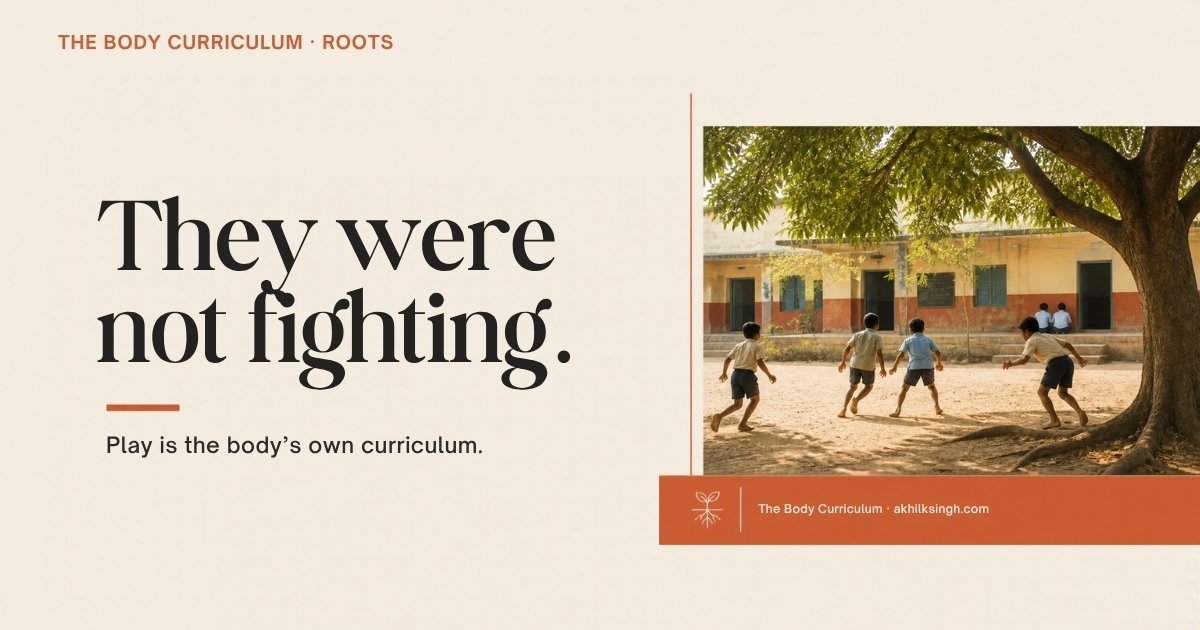
Eleven o’clock, and the bell for the short break has barely stopped ringing. Steel tiffin lids clatter on the verandah, and under the neem tree two boys from Class III are rolling on the ground, one pinning the other’s arms, both shrieking with laughter. Then a whistle cuts through the heat. “Stop fighting! Both of you, come and stand here.” The boys get up, shirts brown with dust, chests heaving, the grins sliding off their faces. They were not fighting. Everyone in the courtyard knew it except the adult.
Ten minutes later they are back on their benches, hands folded, and the real lesson of the morning has already been taught.
What play is, in plain words
Play is hard to define and easy to recognise. The United Nations Committee on the Rights of the Child, explaining the right to play under Article 31 of the Convention, describes it as any behaviour or activity that children themselves start, control and shape. It is never compulsory and is done for its own sake. A 2018 report from the American Academy of Pediatrics, led by Michael Yogman, adds that play comes from within, keeps the child actively engaged and ends in “joyful discovery”. Both put the child’s own authorship at the centre, not the toy.
Much of play is plainly bodily. Peter Smith and Anthony Pellegrini describe exercise play (running, climbing, chasing, skipping to the rhythm of a chant) as something that grows through the toddler and preschool years, peaks in the early primary years and then declines. Rough-and-tumble play, the play fighting our two boys were doing, has its own grammar. Smith and Jennifer StGeorge point to the signs that set it apart from real aggression. There is a play face and laughter, restraint in the blows, children taking turns at being on top, and staying together when it ends. In the primary years, Smith and Pellegrini report, only about one in a hundred such bouts turns into a real fight. Teachers often stop it anyway, on the common belief that play fighting breeds aggression.
Where the idea comes from
In a text from 1933, Lev Vygotsky described a child riding a stick as if it were a horse. The stick, he argued, becomes a “pivot” that lets meaning come away from the thing. In play the child moves beyond his everyday self, as though he were “a head taller than himself”. And play is full of rules. A girl playing at being a mother or a shopkeeper must behave as mothers and shopkeepers behave, which is why so much early play is imitation carried out with the whole body. Vygotsky saw that in keeping to such rules children give up what they want in the moment. Self-control is practised in a game long before anyone lectures a child about it.
Indian policy, on paper, agrees. The National Curriculum Framework for the Foundational Stage, released in 2022 for children from three to eight, says that children “learn best through play” and names play and activity as the primary ways of learning at this stage. That is a real shift for a system that has long treated the playground as the place you go after the learning is over.
What the evidence can and cannot say
Play has many cheerleaders, so honesty matters. Angeline Lillard and her colleagues reviewed decades of research on pretend play and found that the evidence does not support strong causal claims that it is uniquely important for development. Peter Gray links the shrinking of free play in the United States to rising anxiety and depression among the young, yet he says plainly that correlation does not prove causation. These are warnings, not proof that more play will raise marks.
A claim about what a child is
This is where I part ways with the usual case for play. Most arguments for it are instrumental. Play builds executive function, so schedule it. Movement sharpens attention, so add a break. If those payoffs prove thinner than hoped, play loses its slot. That is a fragile foundation.
The deeper point is simpler. Play is how a young body finds out what the world is and what it can do in it. When a child balances on a low wall, chases a friend or turns a stick into a horse, she is not getting ready to learn. She is learning with her whole body, on her own terms. It is her body’s own curriculum, and she is the one writing it. Schools can turn even this into a worksheet, a “structured play” period led by the teacher and timed, with the child once again sitting still and waiting for instructions. The framework lists free play beside guided and structured play. In a crowded classroom with a syllabus to finish, which one do you think survives?
Go back to the courtyard under the neem tree. Two boys were reading each other’s faces, judging how hard to push, letting the other win a turn, laughing all the while. In ten loud minutes they were practising trust, restraint and fairness with their muscles. Then the whistle blew. What did that whistle teach them about their own bodies, and about who decides what counts as learning?
Put it into practice: P51 Free play: what the teacher does while children play · P53 Rough-and-tumble play: when to step in and when not to · P54 Loose parts: sticks, stones and open-ended play
Read next: R54 The vanishing playground · R42 Imitation: children learn by becoming others
Notes
- UN Committee on the Rights of the Child (2013). General Comment No. 17 on the right of the child to rest, leisure, play, recreational activities, cultural life and the arts (art. 31). CRC/C/GC/17. hrlibrary.umn.edu/crc/gencom17.html
- Yogman, M., Garner, A., Hutchinson, J., Hirsh-Pasek, K., & Golinkoff, R. M. (2018). The power of play: A pediatric role in enhancing development in young children. Pediatrics, 142(3), e20182058. https://doi.org/10.1542/peds.2018-2058
- Smith, P. K., & Pellegrini, A. (2013, rev. ed.). Learning through play. In Encyclopedia on Early Childhood Development. PDF
- Smith, P. K., & StGeorge, J. M. (2022). Play fighting (rough-and-tumble play) in children: Developmental and evolutionary perspectives. International Journal of Play. https://doi.org/10.1080/21594937.2022.2152185
- Vygotsky, L. S. (1933/1966). Play and its role in the mental development of the child. Voprosy psikhologii, 1966, No. 6. Trans. C. Mulholland. marxists.org
- National Steering Committee for National Curriculum Frameworks (2022). National Curriculum Framework for Foundational Stage. NCERT. ncf.ncert.gov.in
- Lillard, A. S., Lerner, M. D., Hopkins, E. J., Dore, R. A., Smith, E. D., & Palmquist, C. M. (2012). The impact of pretend play on children’s development: A review of the evidence. Psychological Bulletin, advance online publication. https://doi.org/10.1037/a0029321
- Gray, P. (2011). The decline of play and the rise of psychopathology in children and adolescents. American Journal of Play, 3(4), 443–463. PDF
2 thoughts on “Play: the body’s own curriculum”