Roots
Why the body is central to learning. Sixty articles in five strands.
3 of 60 published
Newest
Before birth: what the body begins to learn in the womb
A child meets the world first through movement, touch and posture. What that contact feels like decides what gets noticed, and only then does any of it become a concept.
I research how bodies learn, advise schools and universities on curriculum, and train teachers to work with what a learner's body is already doing.
Assistant Professor · Ramaiah University of Applied Sciences, Bengaluru

A three-hour, hands-on online workshop for researchers in the humanities and social sciences, with AIRnD Lab. Sunday 1 November 2026, 10:00 AM…
Reserve a seat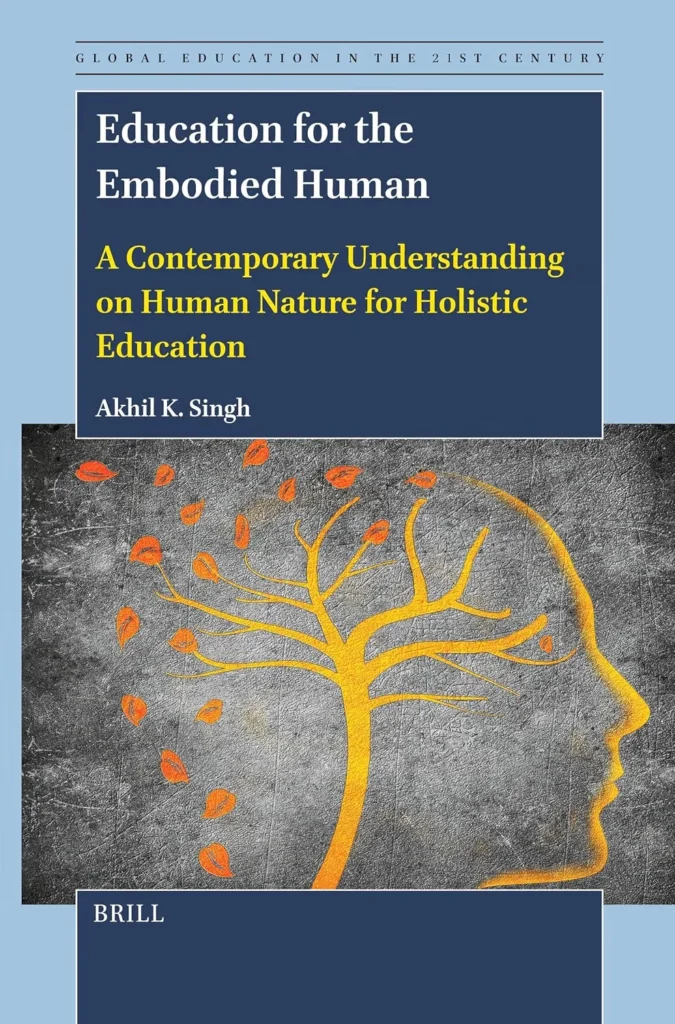
A Contemporary Understanding of Human Nature for Holistic Education
Every education system rests on an answer to one question, usually unasked: what is a human being? The book examines how those buried assumptions shape our educational concepts, and builds an evidence-based account of human nature in their place, drawing on embodied cognition.
It reads Freire, Dewey and Krishnamurti to show that each one's educational thought follows from a view of human nature, and argues that the view most schools still run on has been overtaken by the evidence. The final chapters set out the outer and inner curriculum as the practical consequence.
Brill · 2025Global Education in the 21st Century, Vol. 14Scopus indexed
Why the body is where learning begins. Two series of articles, in English and Hindi, built one piece at a time.
Why the body is central to learning. Sixty articles in five strands.
How a teacher works with the body, moment by moment through the school day.
Two rounds, under a minute. Decide by looking, then decide by touching, and compare.
Three more experimentsRound one of two
Can the shape be turned to fill the socket? Decide by looking. Don't touch it.
The shape
The socket
Six questions about an ordinary day. Answer for the classroom as it is, not as the policy says it should be. Nothing is stored.
Is a still child usually taken to be an attending child?
Do children move during lessons, not only between them?
Do children handle objects while learning number and language?
Can children use fingers, notes or tools during assessment?
Does the day begin by settling bodies before content begins?
Do teachers get time to observe children, not only to deliver?
In the first two years, almost all learning happens through movement, touch and voice. Slide to your baby's age.
0 to 3 months
Try todayLie back and put your baby on your chest, face to face, for a few minutes.
3 to 6 months
Try todayHold a toy just within reach and wait. Let your baby do the last bit of reaching.
6 to 9 months
Try todayGive two steel spoons and a bowl. Let the noise happen.
9 to 12 months
Try todayName what your baby points at, then wait for them to look back at you.
12 to 18 months
Try todayLet them carry something real, a small cloth or a light bag, from one room to another.
18 to 24 months
Try todayPretend together. A cup of tea that isn't there is serious work.
Every baby moves on their own timetable, and these ranges are wide on purpose. If something worries you, your paediatrician is the right person to ask.