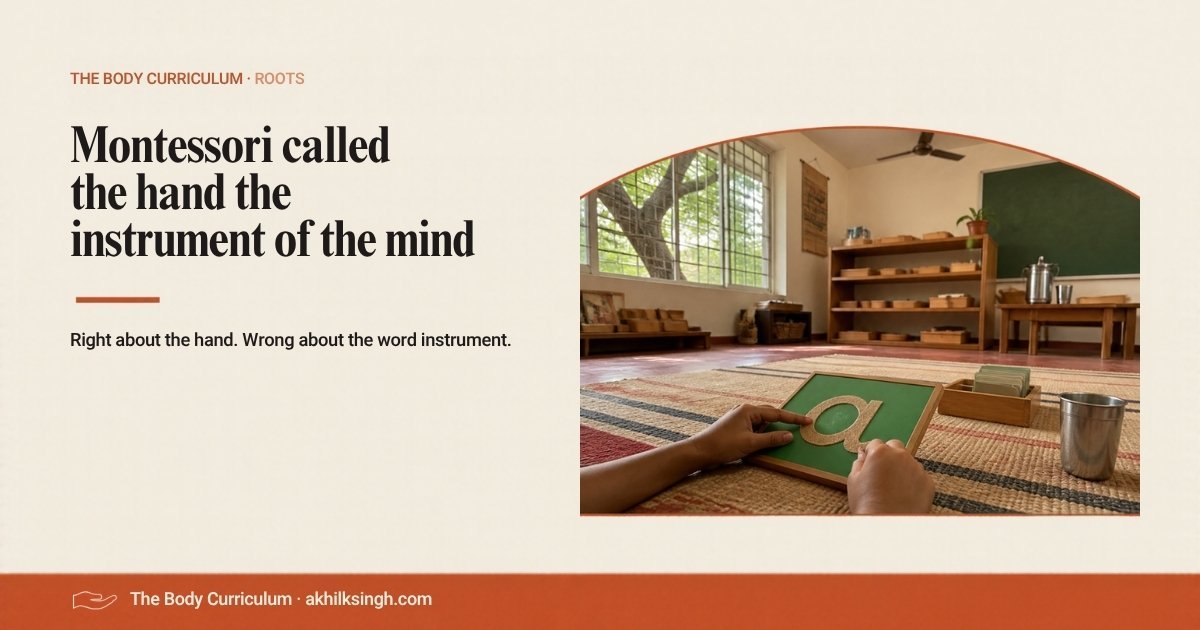
The letter is cut from fine sandpaper and glued onto a small green board. A four-year-old girl sits cross-legged on a cotton durrie, two fingers resting on the rough curve of the letter. The ceiling fan turns slowly overhead. From the courtyard comes the scratch of a coconut-frond broom. She traces the curve once, slowly, the way her teacher showed her, whispering its sound. Then she traces it again. Nobody asked her to. Nobody is watching.
In India the word Montessori is painted on countless playschool gates, usually as a promise of early reading. The woman behind the name was after something larger. She was right about more than the brochures say, and wrong about something that matters.
A doctor among children
Maria Montessori trained as a physician. In the 1890s, as an assistant doctor at the Psychiatric Clinic of the University of Rome, she grew interested in the children the asylums called “deficient”. She read two French physicians, Jean Itard and Édouard Séguin, who had tried to educate such children through the senses and through learning by moving. Some of her pupils, taught this way, passed a public school examination alongside ordinary children. If this could happen for children the system had written off, what might the same methods do for every child?
Her chance came on 6 January 1907 in San Lorenzo, a run-down quarter of Rome. About fifty young children of working families were left alone there during the day, and a room was found for them. It became the first Casa dei Bambini, the Children’s House.
What she saw in the body
Montessori looked at the ordinary school of her day and saw a body under arrest. In The Montessori Method she described children fastened to their desks “like butterflies mounted on pins”. She built the opposite. In her rooms children choose their work, move about and do real tasks such as mopping the floor, which she called the exercises of practical life.
Her approach to writing went deep. She separated the movements of the hand from the meaning of the letters and prepared the hand first. The child touches sandpaper letters and traces their shape with her fingers, because, Montessori argued, muscular memory is the most tenacious kind in a young child. When the hand was ready, she observed, writing did not arrive gradually. It came “in an explosive way”. Anyone who has watched a fist around a crayon slowly become a pencil grip knows what she was watching.
India shaped her too. Invited by George Arundale, president of the Theosophical Society, and Rukmini Devi, she arrived in 1939, ran the first Indian Montessori training course at Adyar in Madras, and stayed through the war until 1946, returning from 1947 to 1949. Her study of children under three in those years fed into The Absorbent Mind (1949), which carries the line in this article’s title. “The hands are the instruments of man’s intelligence.”
The evidence today is encouraging, within limits. Angeline Lillard and her colleagues followed 141 children who had entered a lottery for two public Montessori preschools in Hartford, Connecticut. Over three years the winners grew faster in academic achievement and in understanding other minds, with a smaller gap between richer and poorer children. The authors note it was two schools in one city, and that uneven drop-out may have tilted the results.
The instrument and the player
So where does this series part ways with her? In two places.
The first is play. Montessori had little patience for pretending. Lillard, who admires her, writes that pretend play “has no place” in Montessori education. Yet a child who straddles a stick, calls it a horse and gallops across the courtyard is not wasting time. Her whole body is trying out an “as if”, and play of this kind is one of the oldest ways a body learns.
The second is the phrase itself. An instrument is something a player picks up and puts down, like a carpenter’s chisel. To call the hand the instrument of intelligence seats intelligence somewhere above, directing the hand from a distance. Montessori freed the child’s body in her classrooms, but her language kept an older order, with the mind above and the body below. Work on embodied cognition points the other way. The hand is part of where the thinking happens. Gandhi’s Nai Talim, which also put the hand at the centre, faces the same question. So does the usual case for movement in school, which treats the body as a tool for better marks. The body is not how a learner learns faster. It is what a learner is.
Go back to the girl on the durrie, her fingers on the rough curve, her lips shaping a sound. Montessori saw her more clearly than almost anyone of her time. She saw that the child wanted to move, to touch, to do real work, and that she could concentrate without being told. But when the letter finally settles in her, who has learnt it? A mind that borrowed her fingers for a while, or the girl herself?
Put it into practice: P16 Clay before letters: preparing the hand to write · P18 Air, sand, then paper: three stages of writing a letter · P47 Washing and cleaning up: care as curriculum
Read next: R39 The hand: from grasp to pencil grip · R32 Steiner and Waldorf: rhythm, movement and imagination
Notes
- Montessori, M. (1912). The Montessori Method: Scientific Pedagogy as Applied to Child Education in “The Children’s Houses”. Trans. A. E. George. New York: Frederick A. Stokes. Chapters I, II and XVII. Project Gutenberg edition: https://www.gutenberg.org/ebooks/39863
- Montessori, M. (1949). The Absorbent Mind. The line “The hands are the instruments of man’s intelligence” is cited from p. 25 by the Association Montessori Internationale: https://montessori-ami.org/node/1819
- Association Montessori Internationale. “On this Day: First Casa dei Bambini.” https://montessori-ami.org/news/day-first-casa-dei-bambini
- Association Montessori Internationale Archives. “Montessori in India.” https://archives.montessori-ami.org/montessori-india
- Lillard, A. S., Heise, M. J., Richey, E. M., Tong, X., Hart, A., & Bray, P. M. (2017). Montessori preschool elevates and equalizes child outcomes: a longitudinal study. Frontiers in Psychology, 8, 1783. https://doi.org/10.3389/fpsyg.2017.01783
- Lillard, A. S. (2013). Playful learning and Montessori education. American Journal of Play, 5(2), 157–186. Ages 3–6For teachers
1 thought on “Montessori: the hand as the instrument of the mind”