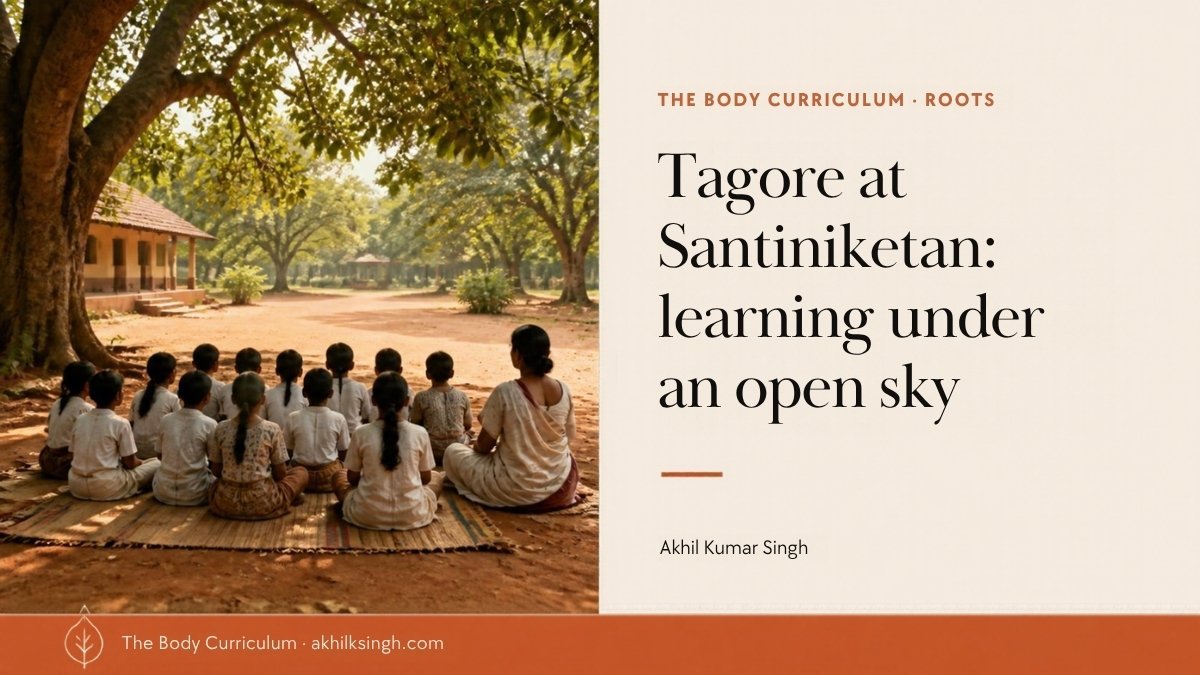
Picture a winter morning in Birbhum. The red earth is still cool under bare feet. A small ring of children sits on woven mats beneath a tree, notebooks open on their knees, and the teacher sits with them. A koel calls from somewhere in the branches. When the sun shifts, the whole class shifts with it, a few metres to the left, back into the shade. At Patha Bhavana, the school Rabindranath Tagore began in 1901, classes are still held in the open air under the trees.
Now picture the school most of us went to. The ceiling fan turning overhead, the smell of chalk and steel tiffin boxes, the barred window with a neem tree outside that you were told not to look at. Two schools, two ideas of where a child’s mind is supposed to be.
The boy in the fork of a tree
Tagore was miserable at school as a boy. In “My School”, a lecture he gave in America in 1916, he said the ordinary school had pinched and bruised his nature at every movement, like the bound shoes of a mandarin woman. He called it a “manufactory” built for grinding out uniform results. Notice that the image is about the body before it is about the mind.
In the same lecture he defends a boy who preferred to study in the fork of a tree rather than at a desk. Childhood, he argued, is the one time a civilised person can still choose between the branches of a tree and the drawing-room chair. He noticed that boys who climb learn, through their hands and feet, where to find a foothold on the trunk and how to spread their weight so the thin branches hold. That is knowledge. It lives in the body, and no textbook hands it over.
What Santiniketan tried
The school opened on 22 December 1901 with five students on the roll. Visva-Bharati’s own history calls it a conscious repudiation of the system the British had brought to India. Lessons happened under trees, and music, painting and drama sat at the centre. A university, Visva-Bharati, followed in 1921, and a centre for rural reconstruction at Sriniketan in 1922. In 2023 UNESCO listed Santiniketan as a World Heritage site.
Tagore’s sharpest diagnosis came as a story. In “The Parrot’s Training” (1918), a king decides an ignorant bird needs schooling. It gets a golden cage and a stuffing of copied pages, and when it resists, its wings are clipped. It dies, and the only sound left is the rustle of book-leaves inside it. At the end the king asks whether the bird can hop or fly. It cannot. The failure of that education is a bodily failure.
Tagore grasped what cognitive scientists now call embedded cognition. The place does part of the teaching. Branches offer a child things to do, which is exactly what the idea of affordances describes, and a child who answers that invitation is thinking with her whole body. Tagore also understood that play and delight are not breaks from learning. The highest education, he said, is the kind that does more than give us information.
What he got right, and what he left out
He got the central thing right. A child is not a head waiting to be filled. The senses and the moving limbs are where a child first meets the world, and a school that cuts her off from them is not neutral. That is the core of embodied cognition, said by a poet decades before the science had a name for it.
But Tagore’s body is mostly the body of delight. He wrote far less about the body that must repeat the same stroke a thousand times until the hand knows it, the slow work Indian traditions call abhyāsa (steady practice). And look at how his own institutions divided things. In 1924 he started Siksha-Satra, a school for village boys, where weaving and small repairs were part of daily learning. Why did the hand’s ordinary work need a separate school? Gandhi drew the opposite conclusion in Nai Talim and put the craft at the centre for every child.
There is a harder problem. Santiniketan had land, trees and small numbers. Most Indian children learn in crowded rooms. It is easy to copy the picture, a class under a tree on a sunny day, and miss the freedom that gave it meaning. Embodiment is not a pleasant setting or a technique for better marks. It is a claim about what a learner is. The real question is not whether every school can have a mango tree. It is whether a child counts as a body inside whatever room she is given.
So go back to the classroom with the ceiling fan, after six hours of sitting. A girl in the third row is watching a squirrel run down the neem outside. The teacher taps the board. If the tree is what she most wants to learn from, what exactly are we teaching her when we tell her to look away?
Put it into practice: P26 The learning walk: taking a lesson outside · P42 Watching closely: observation as a practice · P20 Soil and seeds: a classroom garden as hand learning
Read next: R25 Gandhi’s Nai Talim: education through the hand · R5 Embedded cognition: why the room teaches before the teacher speaks
Notes
- Tagore, Rabindranath. “My School.” In Personality: Lectures Delivered in America. London: Macmillan, 1917. Excerpt reproduced in Lapham’s Quarterly: laphamsquarterly.org/node/12088.
- Tagore, Rabindranath. “Tota Kahini” (1918), translated as “The Parrot’s Training”, The Modern Review, 1918; reprinted in The Parrot’s Training and Other Stories (1944). Summary and publication details: Literature of Colonial South Asia, Lehigh University.
- Visva-Bharati. “History.” visvabharati.ac.in/History.html; “Patha Bhavana.” visvabharati.ac.in/home/patha-bhavana/.
- Visva-Bharati. “About Visva-Bharati” (on Sriniketan, 1922, and Siksha-Satra, 1924). visvabharati.ac.in (PDF).
- UNESCO World Heritage Centre. “Santiniketan.” Inscribed 2023. whc.unesco.org/en/list/1375.
For teacher educatorsFor teachers