The moment
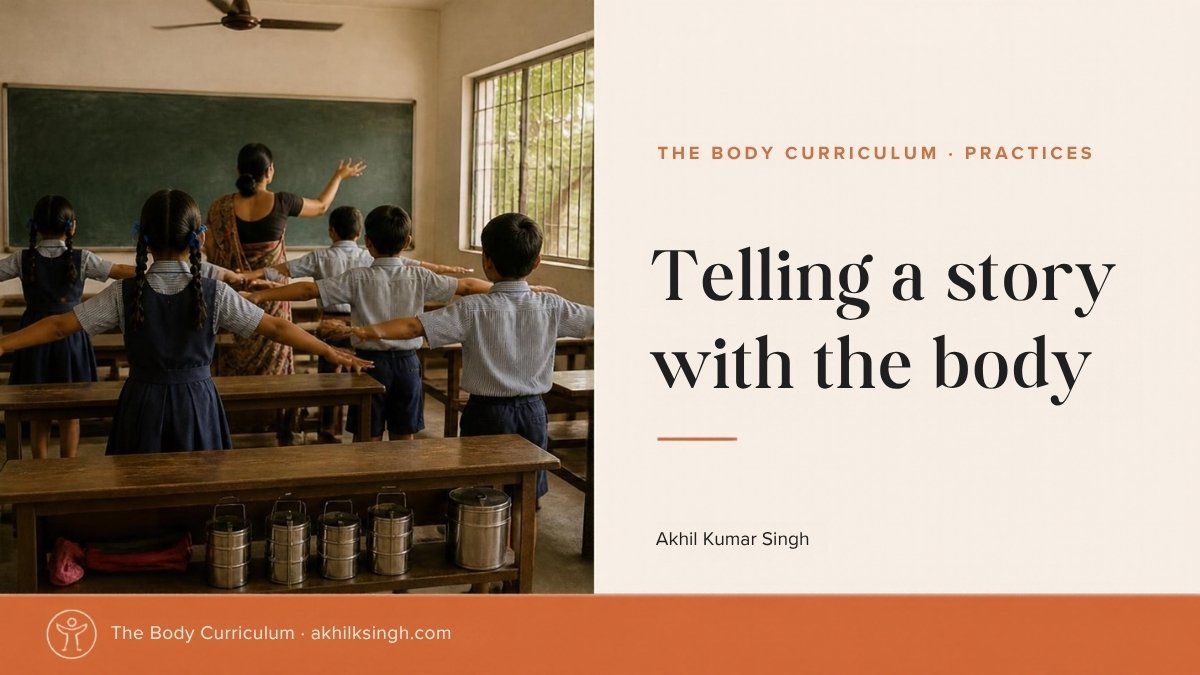
It is the last period before lunch. The ceiling fan turns slowly, the room smells of chalk and of tiffin boxes waiting under the benches, and outside a crow keeps calling. The teacher is reading the story of the thirsty crow. Forty children sit with their hands folded on their desks, as they have been told. When she reads that the crow drops a pebble into the pot, a small boy in the second row lifts an invisible pebble between thumb and finger and lets it fall. Two children beside him do the same. The teacher almost tells them to sit properly.
That movement was not restlessness. The boy was understanding the story the way a seven-year-old understands most things, by doing it.
The practice
Choose a short story with clear actions in it, such as a folk tale, a fable or a scene from a chapter the class is reading. Three to six events are enough. You need no materials, only room for each child to stand beside their seat. Allow fifteen to twenty minutes the first time and less once the routine is familiar. Two or three times a week is plenty, with the whole class and then in groups of four or five.
Begin by telling the story once, simply, with your own voice and hands. Ask for nothing yet.
Then tell it again, slowly, and invite everyone to move with you. When the crow flies, arms become wings. When the pot is heavy, shoulders bend. Show each movement once and let children find their own version, because a wing can be two fingers or a whole arm. Children learn a great deal through imitation, but the aim is not an exact copy of you. It is the story passing through their own bodies.
Next, divide the class into small groups. One child narrates while the others act, and then they swap. Walk around and listen.
Finally, ask two or three children to tell the story to the class, with movement or without it. Close by asking which moment their body remembers best.
Before anyone moves, make sure there is clear space around each child so that flying arms do not meet faces. Acting never involves touching another child unless both agree, and no child is made to perform in front of the class.
What to watch for
When it is working, gestures arrive a fraction before the words, as if the hand is reminding the mouth what comes next. Faces change with the story. Retellings grow longer and keep events in order. Quieter children often move first and speak later.
When it isn’t working, the movements turn silly and drift from the story, or a few confident children take over. Shorten the story and give each group a single moment to act, or to freeze as a still picture.
Some children will refuse. Let them watch, since watching is still taking part, and many join in a few days later. A shy child may find it easier to move a puppet. If a child keeps struggling with coordination, or cannot follow a simple sequence of actions over several weeks, mention it gently to the parents and suggest they speak to a paediatrician or an occupational therapist.
Why it works
Arthur Glenberg and his colleagues asked young readers to act out a farm story with toys. Those children understood and remembered the story clearly better than children who simply reread it, and so did children who only imagined moving the toys. Katie Bernstein and her colleagues found that preschoolers given a drama-based story time used about twice as many story-related gestures and movements when retelling, and these embodied retellings went with remembering more of the story.
Susan Goldin-Meadow and her colleagues found that children asked to make the right gestures during a maths lesson learned more than children asked to make none, which suggests gesture helps children reach new ideas, not only hold old ones. Acting out simple phrases also tends to help memory, though Melanie Steffens and her colleagues show this holds under some conditions and not others. Movement is a strong ally, not a magic trick.
The Nāṭyaśāstra already counted āṅgika abhinaya, expression through the body and its limbs, among the four ways meaning reaches an audience. A story is a sequence of things that bodies do and feel. So why do we ask children to fold their hands at exactly the moment a story invites them to move?
Why this works: R2 Enaction: knowing as a form of doing · R11 Gesture as thinking: what the hands know before words · R17 Rasa: feeling as a way of knowing · R42 Imitation: children learn by becoming others
Next in Story and drama: P37 Freeze frames: acting out a scene
Notes
- Glenberg, A. M., Gutierrez, T., Levin, J. R., Japuntich, S., & Kaschak, M. P. (2004). Activity and imagined activity can enhance young children’s reading comprehension. Journal of Educational Psychology, 96(3), 424–436. https://doi.org/10.1037/0022-0663.96.3.424
- Bernstein, K. A., van Huisstede, L., Marley, S. C., Gao, Y., Pierce-Rivera, M., Ippolito, E., Restrepo, M. A., Millinger, J., Brantley, K., & Gantwerker, J. (2024). Gesture like a kitten and you won’t forget your tale: Drama-based, embodied story time supports preschoolers’ narrative skills. Early Childhood Research Quarterly, 66, 178–190. Publication page
- Goldin-Meadow, S., Cook, S. W., & Mitchell, Z. A. (2009). Gesturing gives children new ideas about math. Psychological Science, 20(3), 267–272. https://doi.org/10.1111/j.1467-9280.2009.02297.x
- Steffens, M. C., von Stülpnagel, R., & Schult, J. C. (2015). Memory recall after “learning by doing” and “learning by viewing”: Boundary conditions of an enactment benefit. Frontiers in Psychology, 6, 1907. https://doi.org/10.3389/fpsyg.2015.01907
- Bharata, Nāṭyaśāstra, on the four kinds of abhinaya (āṅgika, vācika, āhārya, sāttvika). Summary at Wisdom Library, “Abhinaya”. https://www.wisdomlib.org/definition/abhinaya