The moment
It is a few minutes past the bell. Bags thud onto benches, a steel water bottle rolls under a desk and clangs against a leg, and two children at the back are still arguing about a pencil. The teacher opens the register. A name, “Present.” Another name, “Present.” Thirty children answer in thirty flat voices, each half turned towards a friend. By the last name the room has gone quiet, but it has not settled. The children have been counted, but nobody has met them.
The practice
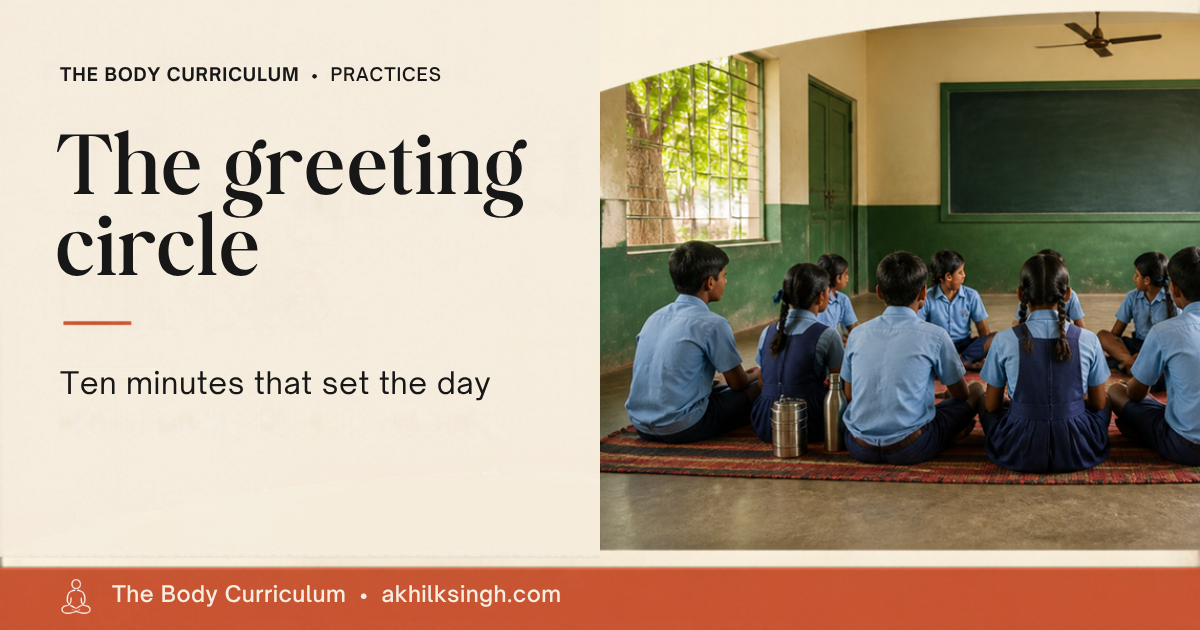
Begin once the children have crossed the threshold. Push the benches back or sit on the floor in one circle where every face can see every other. Sit in it yourself, at the children’s height. It takes ten minutes each morning before the first lesson, with fifteen children or forty. With a very large class, make two rows or two circles with a second adult. You need only space.
Then the greeting. Turn to the child beside you, say their name and greet them. That child turns to the next and does the same, until the greeting comes back round to you. Children choose how to greet, with a wave, a nod, a namaste or a hand on the heart, and a handshake only if both want it. Touch is offered, never required. In the first weeks keep one simple form, so no child has to invent something in front of everyone.
Then a rhythm. Pat your knees twice and clap once, and let the circle join in. Slow it down and end together on a single clap. In a minute or two it does what words cannot. It brings thirty separate bodies into one beat.
Then a little sharing. Ask two or three children, not all of them, to say one thing they noticed on the way to school. Rotate over the week so every child gets a turn.
Finally, say one sentence about the day ahead, stand up together and go back to your places.
What to watch for
When it is working, the body tells you before words do. Children turn their whole torso towards the child being greeted. Shoulders drop. A name whispered in the first week is said clearly by the fourth.
When it is not working, the circle turns into a performance. Children rush, giggle at a name, or stare at the floor when their turn comes. Slow down, model the greeting again, and shorten the practice if you need to. A child who will not speak can wave instead, and a child who will not join can sit just outside the circle and watch. A pass is always allowed. Pressure turns a welcome into a test.
If a child stays withdrawn or distressed for several weeks, talk gently with the parents. If a child does not seem to hear their name, or struggles to form words, bring in the school counsellor or a specialist.
Why it works
Hanne De Jaegher and Ezequiel Di Paolo argue that understanding between people is made in the coordination of their movements and voices, not only inside each head. They call this participatory sense-making, and it is what a greeting circle does. “We are a class” is built in the turning, the naming and the shared beat. Tal-Chen Rabinowitch and Andrew Meltzoff had pairs of four-year-olds swing in time or out of time, and the in-time pairs then finished shared tasks faster. Later researchers warn that expectations can inflate such results, so take this as a hint, not a law.
Greetings have been tested more directly. Clayton Cook and his colleagues randomly assigned middle school teachers to greet students positively at the door, and engaged time rose while disruptive behaviour fell. Morning Meeting, in the Responsive Classroom approach, opens the day with greeting, sharing and a group activity. Sara Rimm-Kaufman’s three-year trial of that approach found achievement improved where teachers used the practices well, not merely where schools signed up. No study has tested the circle alone. Together, though, these findings suggest that how children are met shapes how they learn.
Indian thought has an older word for what the circle builds, śraddhā, the trust that lets a person receive what another offers. A child seen by name, at eye level, by the teacher and by the children on either side, carries a little more of that trust into the first lesson. So what does a child learn about belonging when the first adult voice of the day is reading names off a list?
Why this works: R10 Participatory sense-making: how two bodies understand together · R18 Śraddhā: trust as a condition for learning · R40 Rhythm: why children learn through beat and repetition
Next in Arriving and greeting: P3 Reading the arriving body: what a teacher can see in thirty seconds
Notes
- De Jaegher, H., & Di Paolo, E. (2007). Participatory sense-making: An enactive approach to social cognition. Phenomenology and the Cognitive Sciences, 6, 485–507. https://doi.org/10.1007/s11097-007-9076-9
- Rabinowitch, T.-C., & Meltzoff, A. N. (2017). Synchronized movement experience enhances peer cooperation in preschool children. Journal of Experimental Child Psychology, 160, 21–32. https://doi.org/10.1016/j.jecp.2017.03.001
- Atwood, S., Schachner, A., & Mehr, S. A. (2022). Expectancy effects threaten the inferential validity of synchrony-prosociality research. Open Mind: Discoveries in Cognitive Science, 6, 280–290. https://doi.org/10.1162/opmi_a_00067
- Cook, C. R., Fiat, A., Larson, M., Daikos, C., Slemrod, T., Holland, E. A., Thayer, A. J., & Renshaw, T. (2018). Positive greetings at the door: Evaluation of a low-cost, high-yield proactive classroom management strategy. Journal of Positive Behavior Interventions, 20(3), 149–159. https://doi.org/10.1177/1098300717753831
- Kriete, R., & Davis, C. The Morning Meeting Book (3rd ed.). Center for Responsive Schools.
- Rimm-Kaufman, S. E., Larsen, R. A. A., Baroody, A. E., Curby, T. W., Ko, M., Thomas, J. B., Merritt, E. G., Abry, T., & DeCoster, J. (2014). Efficacy of the Responsive Classroom approach: Results from a 3-year, longitudinal randomized controlled trial. American Educational Research Journal (published online 6 March 2014).