The moment
It is a few minutes before the first lesson. The corridor is loud with slapping sandals and a water bottle rolling across the floor. Bags thump against the doorframe. One child bursts in still mid-sentence, another hangs back with a hand on the frame, and a third slides in along the wall as if hoping not to be noticed. Within five minutes the teacher has called for quiet twice.
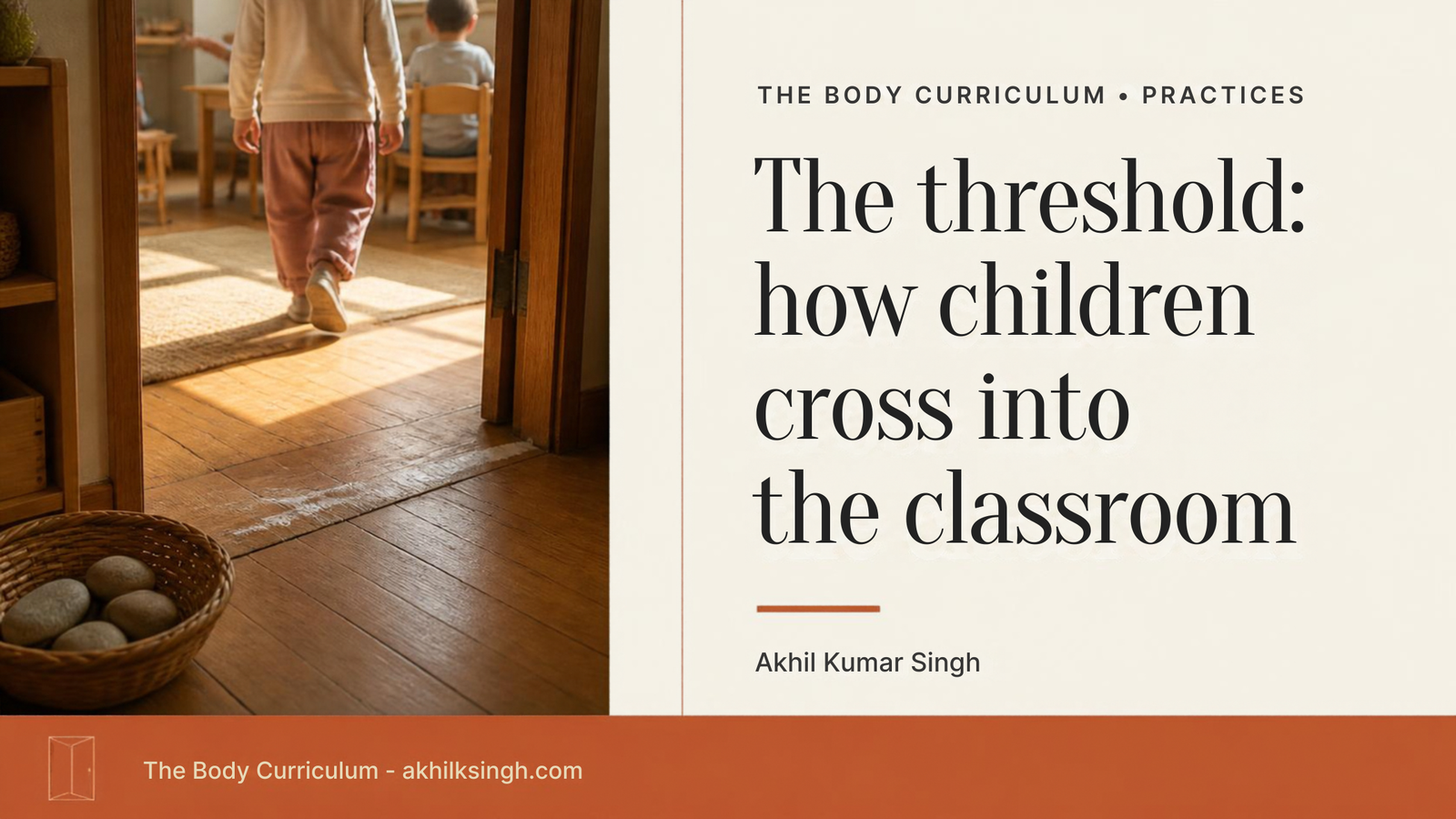
We treat the door as a gap in the wall. But every child who crosses it is making a small journey, into a room that asks something different of their body. What would change if we treated that crossing as the first lesson rather than the noise before it?
The practice
Begin by marking the threshold. A strip of tape, a chalk line or a flat folded cloth just inside the door is enough. This is where the outside ends and the class begins. Keep two small baskets by the door. One holds a stone, bottle cap or name card for each child. The other starts empty.
Then stand at the door every morning for the five to eight minutes it takes a class of thirty or forty to arrive. As each child reaches the line, they pause for one easy breath. You meet their eyes and say their name. The child chooses how to greet you, with a wave, a smile, folded hands, a nod or a handshake, and you return what they offer. Touch is always the child’s choice and never asked for. Then the child moves their stone into the empty basket, a small act of the hand that says “I am here”.
Finally, let the first thing inside be something the body can do alone. Bags go to one fixed place, and the child sits with one quiet task, such as tracing a shape, until the last stone has moved. Do this daily for three weeks before judging it, because repetition is what turns a gesture into something the body does without being told. Keep the line moving and the floor marker flat so no one trips. A child who arrives late gets exactly the same threshold, never a scolding at the door.
What to watch for
When it is working, steps slow near the line, shoulders drop and eyes lift to meet yours. These are the same signs a teacher learns to see when reading the arriving body. Within a week the room settles sooner without your voice having to rise.
When it is not working, the line turns into a queue and a checkpoint. Children push or perform the greeting for you. Shorten it. A name and a glance are enough.
Some children will refuse, freeze or hide behind a parent. Let them cross without the gesture and greet them anyway. Watching is taking part. Never make the threshold a gate that must be paid for. If a child shows strong distress at arrival day after day for several weeks, crying, clinging or complaining of a stomach ache every morning, speak gently with the family, and if it continues, involve the school counsellor or a child specialist.
Why it works
In 1909 Arnold van Gennep described how many cultures mark a change of state with a passage, often through a door or arch, moving from leaving to a middle stage to joining. Victor Turner later called that middle stage “betwixt and between”. A child in the doorway is standing in exactly that middle place.
There is classroom evidence too. Allday and Pakurar found that when a teacher greeted three middle school students at the door, their on-task behaviour in the first ten minutes of class rose from an average of 45 per cent to 72 per cent. Cook and his colleagues tested positive greetings at the door with ten middle school teachers and found more academic engaged time and less disruptive behaviour in the classes that used them. These were older children and a greeting, not this whole routine, so they support its spirit rather than prove it.
Behind both lies a simpler idea. Attention is a bodily act before it is a mental effort, and a room teaches through what it invites the body to do. A child who has been seen and has moved a stone with their own hand has already begun to attend. So why do our schools spend so much thought on what happens after the door, and almost none on the door itself?
Why this works: R5 Embedded cognition: why the room teaches before the teacher speaks · R12 Attention is a bodily act, not a mental effort · R18 Śraddhā: trust as a condition for learning · R44 Touch, safety and the readiness to learn
Next in Arriving and greeting: P2 The greeting circle: ten minutes that set the day
Notes
- Allday, R. A., & Pakurar, K. (2007). Effects of teacher greetings on student on-task behavior. Journal of Applied Behavior Analysis, 40(2), 317–320. https://doi.org/10.1901/jaba.2007.86-06
- Cook, C. R., Fiat, A., Larson, M., Daikos, C., Slemrod, T., Holland, E. A., Thayer, A. J., & Renshaw, T. (2018). Positive Greetings at the Door: Evaluation of a low-cost, high-yield proactive classroom management strategy. Journal of Positive Behavior Interventions, 20(3), 149–159. https://doi.org/10.1177/1098300717753831
- van Gennep, A. (1909). Les rites de passage. English translation published 1960 as The Rites of Passage.
- Turner, V. (1964). Betwixt and between: The liminal period in rites of passage. Proceedings of the American Ethnological Society for 1964, 4–20. Reprinted in The Forest of Symbols (1967), pp. 93–111. Ithaca, NY.
2 thoughts on “The threshold: how children cross into the classroom”