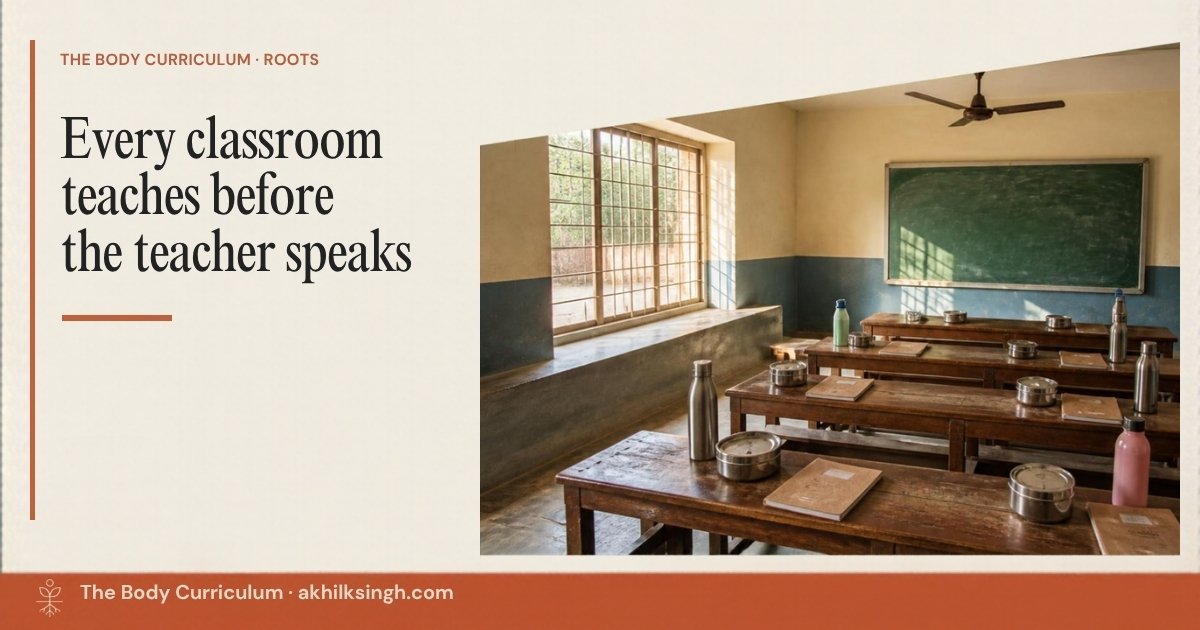
The lunch bell has just gone in a small government primary school. Steel tiffin boxes snap shut, and the smell of dal still hangs in the warm air. Along the back wall of the classroom, under the barred window, runs a low cement ledge about a hand’s width deep. Within a minute three children are sitting on it, legs swinging. A fourth climbs up and walks its full length with his arms stretched out, heel to toe, the way he has seen rope walkers do at a mela. The teacher claps twice. “Neeche utro,” get down. He jumps down, and the slap of his feet on the floor is the loudest sound in the room.
Nobody told him to walk along that ledge. The ledge told him.
What the ledge said
The psychologist James Gibson had a word for this. He called it an affordance, and he admitted plainly that he had made the word up. The affordances of an environment, he wrote, are what it offers an animal, what it provides or furnishes, for good or for ill. A flat, firm surface at knee height offers sitting. A gap offers jumping, or falling.
An affordance, Gibson said, is neither an objective property of the thing nor a subjective idea in the head. It sits between them. A surface affords sitting only relative to the size of the body in front of it. The bench that is a seat for the teacher is a climbing frame for a five-year-old. The ledge that the school architect drew as a strip of cement is, to an eight-year-old body, a path. So a classroom is never one room. It is as many rooms as there are bodies in it.
Learnt with the body, not told to the mind
How does a child come to see what a ledge offers? Not by being told. Karen Adolph studied nine-month-old babies at the edge of an adjustable gap. Babies who judged the gap well while sitting, leaning forward only when they could safely reach, often went over the edge of the same gap when they were put in a crawling position. Adolph concluded that experience with an earlier skill does not transfer automatically to a later one. Each new way of moving has to discover the world afresh.
This is why the first years of crawling, toppling and climbing matter so much, and why movement comes before words. A child does not first know the world and then act in it. Knowing what the world offers grows out of the body that acts, which is the heart of sensorimotor learning. The Finnish researcher Marketta Kyttä found something similar outdoors. Where children could move about on their own, they found more things to do, and finding more things to do drew them further out. She called this kind of place Bullerby. In her data from Finland and Belarus, places like this grew rarer as towns grew more urban, and a type she called the glasshouse grew more common.
The room speaks before the teacher does
The usual way to use this idea in schools is practical. Peter Barrett and his colleagues studied 153 classrooms in 27 schools and found that seven features of the room, among them light, air quality, flexibility and colour, together explained about 16 percent of the variation in pupils’ academic progress.
All of this is useful. But notice what it assumes. The room becomes a tool for raising marks, and the child stays a mind waiting to be instructed, now in better light. My reading of Gibson goes further. If a child is always reading the room for what it lets her do, then every room is already a lesson, whether we plan one or not. Fixed benches in rows facing the blackboard offer sitting, facing forward and copying. They do not offer turning to a friend, standing to think, or building something with the hands. Six years of sitting for six hours a day is not a neutral background to learning. It is what is being learnt.
Gibson also wrote that the richest affordances of all are other people. A teacher’s body is part of the room. Arms folded at the front offer one thing. A teacher crouching to a child’s eye level offers another. This is the room teaching before the teacher speaks, and it is why this series treats embodied cognition as a claim about what a learner is, not a trick for learning faster.
The boy on the ledge
Go back to that classroom after lunch. The ledge invited walking. The boy accepted. The clap told him that accepting was wrong. Nothing harsh happened, and the lesson was small. But lessons like this one are repeated thousands of times across a childhood, in corridors, on shrinking playgrounds, on stairs no one may run down. Slowly a child learns not only to stay off ledges. She learns to stop noticing them.
What does your classroom invite a child to do? And how many of those invitations have we taught children to refuse?
Put it into practice: P15 Rows, circles and clusters: arranging the room for the lesson · P14 Standing to think: when to let children learn on their feet · P54 Loose parts: sticks, stones and open-ended play
Read next: R5 Embedded cognition: why the room teaches before the teacher speaks · R4 Body schema: the body a child learns with
Notes
- Gibson, J. J. (1979). The Ecological Approach to Visual Perception. Houghton Mifflin. Chapter 8, “The Theory of Affordances”.
- Adolph, K. E. (2000). Specificity of learning: Why infants fall over a veritable cliff. Psychological Science, 11(4), 290–295.
- Kyttä, M. (2003). Children in Outdoor Contexts: Affordances and Independent Mobility in the Assessment of Environmental Child Friendliness. Doctoral thesis. Espoo: Helsinki University of Technology.
- Barrett, P., Davies, F., Zhang, Y., & Barrett, L. (2015). The impact of classroom design on pupils’ learning: Final results of a holistic, multi-level analysis. Building and Environment, 89, 118–133.
For school leadersFor teachers
3 thoughts on “Affordances: what a classroom invites a child to do”