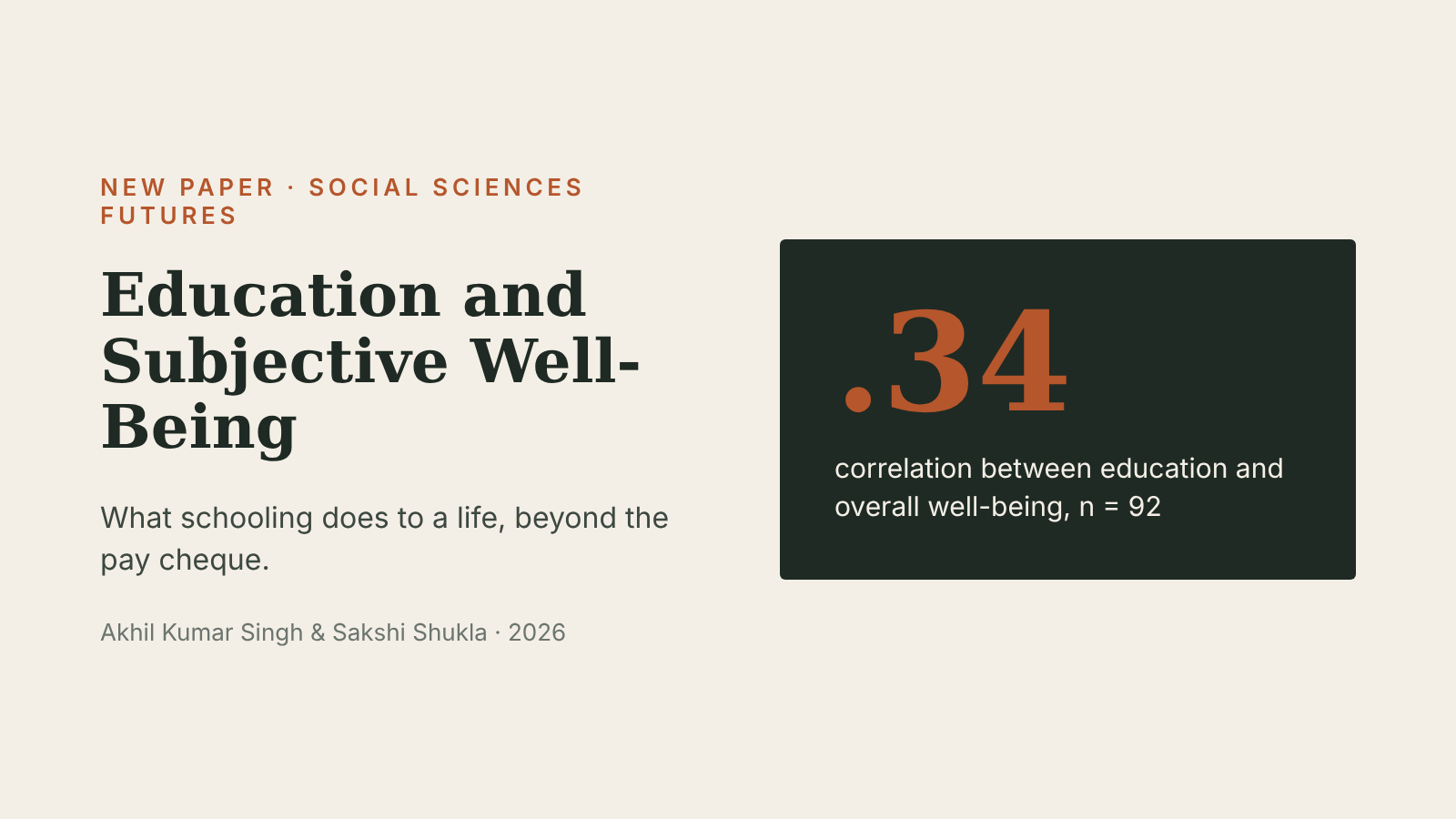
Most arguments for education reduce it to one thing: it gets you a better job, and the job pays better. Sakshi Shukla and I wanted to see what else is going on. Our paper, Education and Subjective Well-Being: A Mixed-Methods Study Across Occupational Groups, is out now in the first issue of Social Sciences Futures, and it is open access.
What we did
We worked with 92 adults around a public university in Jodhpur: unskilled labourers, skilled labourers, students and university lecturers. Their education ranged from no schooling to beyond postgraduate. Everyone completed measures of psychological well-being (Ryff), affect (PANAS) and mind-wandering. Twelve of them also sat for in-depth interviews.
What we found
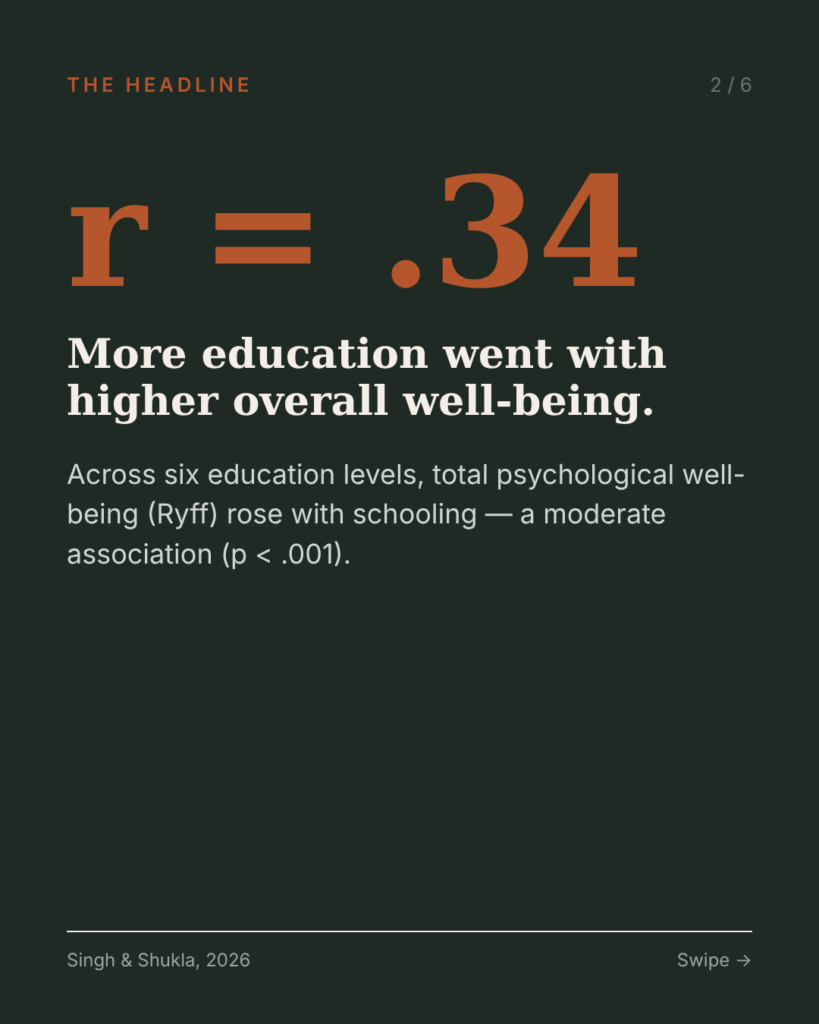
More education went with higher overall well-being (r = .34). It wasn’t a smooth climb. Scores stayed about flat from no schooling to undergraduate level and moved up at postgraduate level.

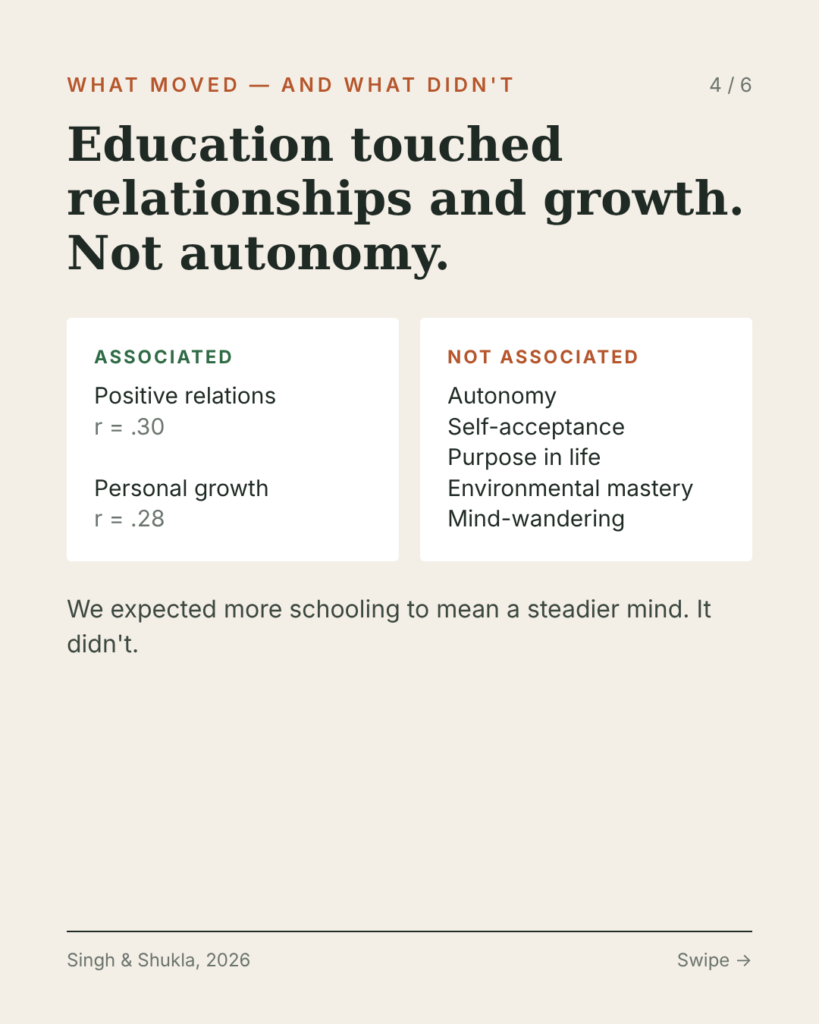
The association was narrow. Education was linked to positive relations with others and personal growth. It was not linked to autonomy, self-acceptance, purpose in life, environmental mastery, or mind-wandering. We had expected more schooling to mean a steadier mind. The data did not show that.
Occupation did not predict well-being. Education did. Labourers, students and lecturers did not differ significantly. In the interviews people talked about education as a source of self-respect, perspective, emotional balance and the ability to relate to others, more than as a route to employment.

Why it matters
If what education mainly gives people is relational, that can’t be left to chance. Emotional regulation, interpersonal skill and self-awareness should be taught on purpose, alongside academic attainment.
The caveats
This is an exploratory study with a small, single-site, non-probability sample and a cross-sectional design. It shows associations, not causes. The next step is longitudinal work.
Read the paper: Singh, A. K., & Shukla, S. (2026). Education and subjective well-being: A mixed-methods study across occupational groups. Social Sciences Futures, 1(1), 21–31. https://doi.org/10.68802/ssf.v1i1.46