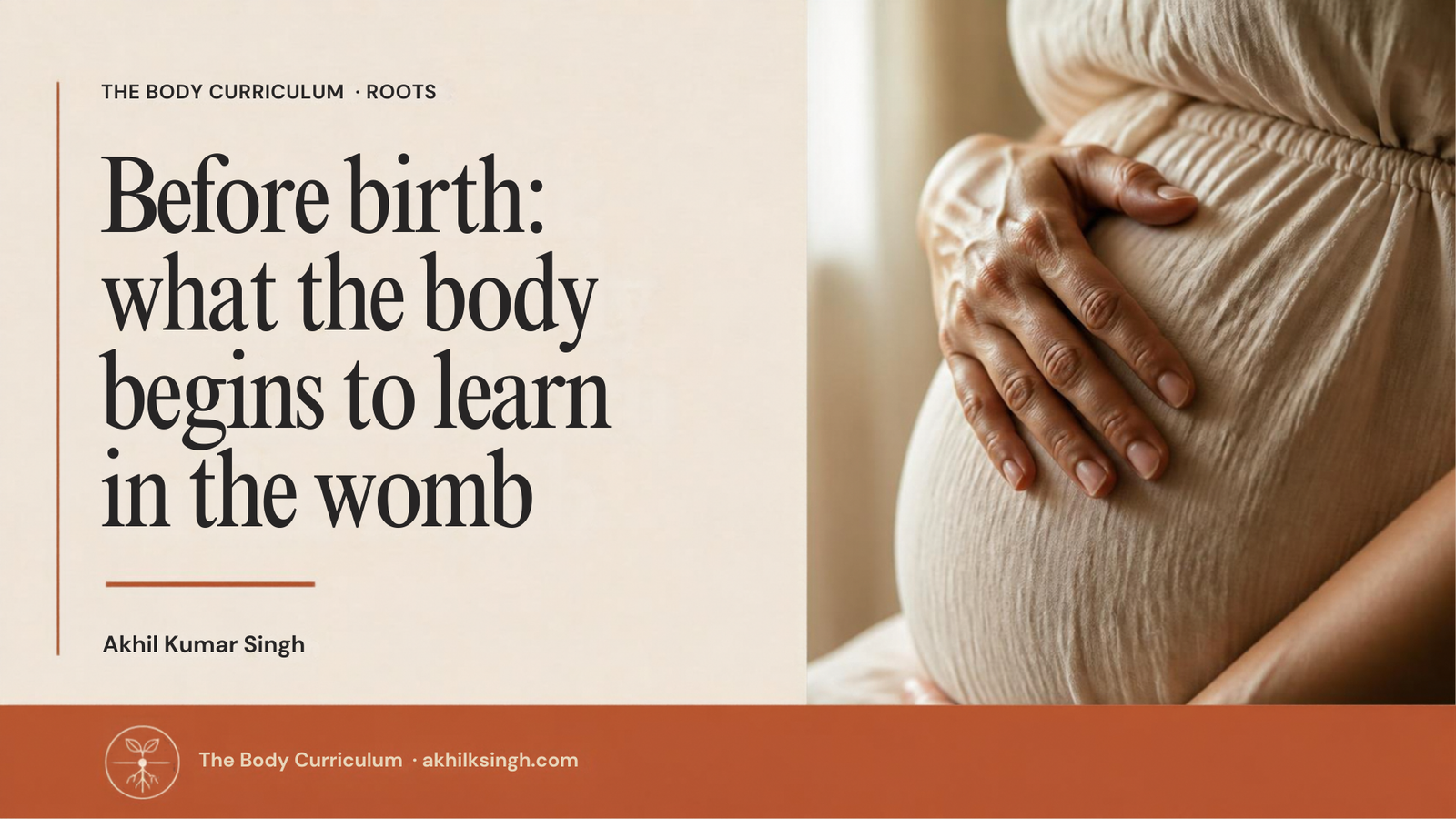
It is late in the evening and the kitchen still smells of mustard seeds crackling in hot oil. A woman in her eighth month sits on a low stool, one hand resting on the curve of her belly, the other stirring the dal. From the next room her mother-in-law hums the same old bhajan she hums every night. Under the woman’s palm something shifts, a slow roll and then a sharp push against the ribs. She laughs and calls out that the baby is listening.
Is she right? In the popular retelling of the Mahabharata, Abhimanyu overhears how to break into the cakravyūha (a spiral battle formation) while still in his mother Subhadra’s womb, and misses the part about how to get out. It is a beautiful story, and it is a story. The question worth asking is what the body actually begins to learn before birth, and where the evidence stops.
The body moves before it hears
Fetal movements first show up on ultrasound at around eight and a half to nine and a half weeks. Fetuses also suck their thumbs, and Peter Hepper and his colleagues found that most favour one thumb, usually the right. Years later, in most of the children they followed, that thumb predicted the hand they wrote with. This is the slow beginning of the sense of where one’s own limbs are.
Hearing comes later. Hepper and Babu Shahidullah played tones through the mother’s abdomen. The first responses came at around 19 weeks, and only to a low tone. Higher pitches came gradually, and by 33 to 35 weeks every fetus responded across the range they tested.
What the evidence supports
Anthony DeCasper and William Fifer showed in 1980 that newborns prefer their own mother’s voice to that of another woman. Six years later DeCasper and Melanie Spence asked mothers to recite one passage aloud, again and again, in late pregnancy. After birth, the babies preferred it. In Finland, Eino Partanen and his colleagues played a made-up word, “tatata”, to fetuses from the 29th week. After birth, the brains of the exposed babies responded more strongly to the word and to small changes in it. Birgit Mampe, Kathleen Wermke and their colleagues found that French newborns, a few days old, tended to cry with a rising melody and German newborns with a falling one, each echoing their language. Even taste begins here. Julie Mennella and her colleagues found that babies whose mothers drank carrot juice in pregnancy or while breastfeeding enjoyed carrot-flavoured cereal more at weaning.
Notice what these studies show. They show familiarity. The newborn has learnt the tune of a voice, the rhythm of a language, the flavour of a kitchen. They do not show that a fetus understands words, stores facts or takes in values.
Where the evidence runs out
That second claim is the one that sells. In 1993 a study of 36 college students found a brief gain on a spatial task after listening to Mozart. By 1998 the governor of Georgia in the United States was proposing to give every newborn in the state a tape or CD of classical music. In 2010 Jakob Pietschnig and his colleagues pooled about forty studies and found no support for the effect. Closer home, a garbha saṃskāra (prenatal rites and teaching) campaign launched in 2023 claimed that a baby in the womb can learn up to 500 words. I have found no study that shows anything of the kind. The evidence runs out at familiarity, and nobody has shown that playing anything to a fetus makes a cleverer child.
A child is not born blank
The usual case for prenatal learning is a race. Start earlier, get ahead, and the womb becomes the first coaching centre. The evidence points somewhere quieter. A child is not born blank. She arrives already knowing something, and knowing it in her body. She knows a voice by its rise and fall, and the beat of a language. She has kicked, turned and sucked her thumb for months. Her first learning was a body tuning itself to the world it was growing inside. This is what embodied cognition means at its very earliest point. Thinking does not begin in the head and then travel down into the body. It begins as one body living inside another.
This should change how we see the first day of school. The child in Class 1 who cannot sit still and hums under her breath is not starting from zero. She has been learning through movement and through the voice since before she had a name. Our schools often treat that body as a problem. What would it mean to treat it as her first teacher?
Go back to the kitchen. The woman stirring the dal was half right. The baby is not learning the words of the bhajan. It is learning the hum, the warmth of a voice, the rhythm of an evening repeated night after night. That is where a person begins. If the first curriculum is a voice heard from inside a body, what voice do our classrooms give children to grow into?
Put it into practice: P8 Humming together: settling a room through sound · P22 Call and response: language through rhythm · P24 Sound play and tongue twisters for early reading
Read next: R38 Movement before words: crawling, balance and the first two years · R41 Voice: speaking, singing and the body of language
Notes
- de Vries, J. I. P., Visser, G. H. A., and Prechtl, H. F. R. (1985). The emergence of fetal behaviour. II. Quantitative aspects. Early Human Development, 15, 333–348.
- Hepper, P. G., Wells, D. L., and Lynch, C. (2005). Prenatal thumb sucking is related to postnatal handedness. Neuropsychologia, 43(3). doi:10.1016/j.neuropsychologia.2004.08.009
- Hepper, P. G., and Shahidullah, B. S. (1994). Development of fetal hearing. Archives of Disease in Childhood: Fetal and Neonatal Edition, 71(2), F81.
- DeCasper, A. J., and Fifer, W. P. (1980). Of human bonding: Newborns prefer their mother’s voices. Science, 208, 1174–1176.
- DeCasper, A. J., and Spence, M. J. (1986). Prenatal maternal speech influences newborns’ perception of speech sounds. Infant Behavior and Development, 9, 133–150.
- Partanen, E., Kujala, T., Näätänen, R., Liitola, A., Sambeth, A., and Huotilainen, M. (2013). Learning-induced neural plasticity of speech processing before birth. Proceedings of the National Academy of Sciences. doi:10.1073/pnas.1302159110
- Mampe, B., Friederici, A. D., Christophe, A., and Wermke, K. (2009). Newborns’ cry melody is shaped by their native language. Current Biology.
- Mennella, J. A., Jagnow, C. P., and Beauchamp, G. K. (2001). Prenatal and postnatal flavor learning by human infants. Pediatrics, 107(6), e88.
- Rauscher, F. H., Shaw, G. L., and Ky, K. N. (1993). Music and spatial task performance. Nature.
- Pietschnig, J., Voracek, M., and Formann, A. K. (2010). Mozart effect–Shmozart effect: A meta-analysis. Intelligence.
- WION (6 March 2023). “RSS wing launches ‘Garbha Sanskar’ campaign to teach babies culture, values in womb.”
Before birthFor parentsFor teachers
1 thought on “Before birth: what the body begins to learn in the womb”