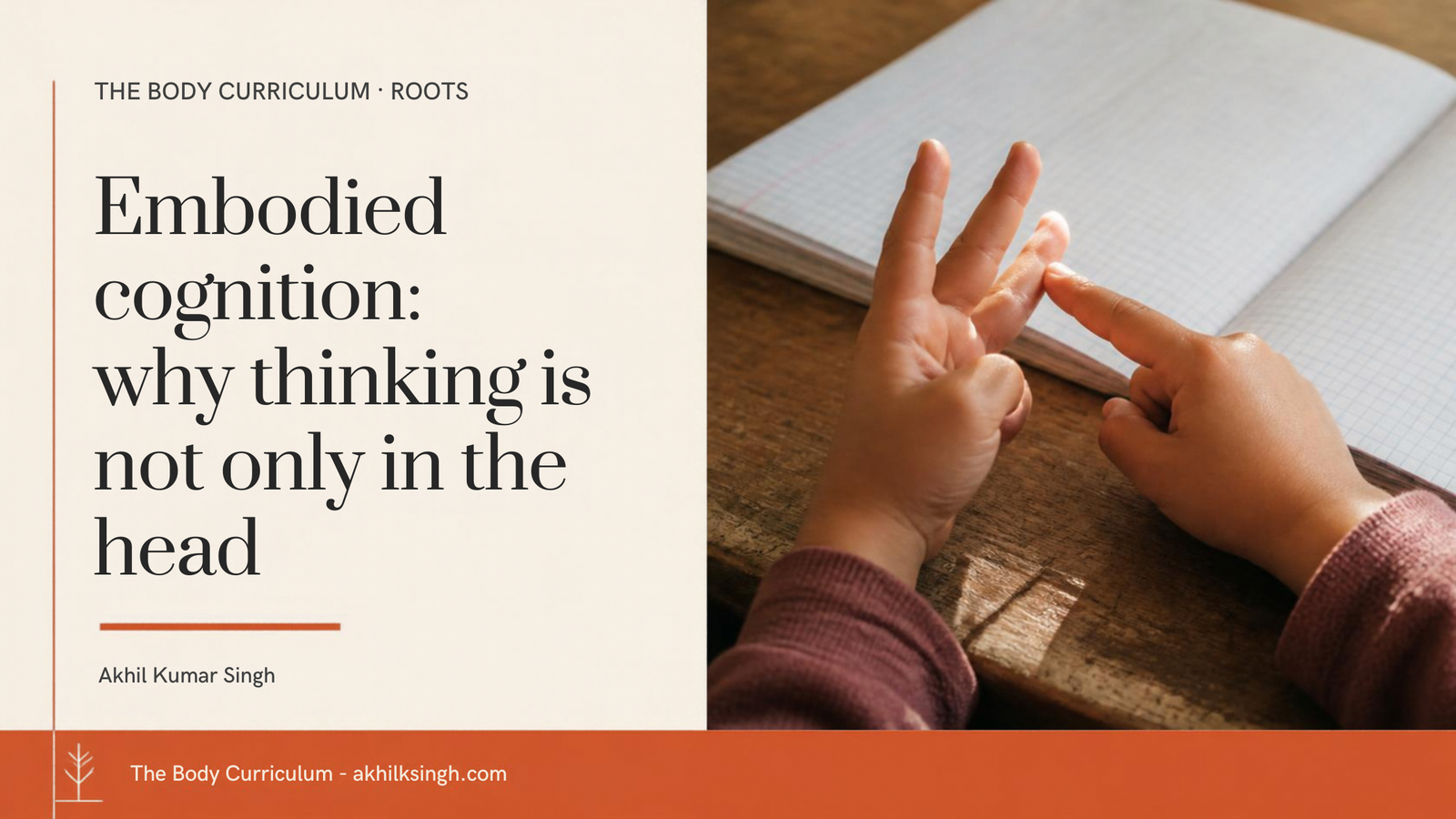
A Class IV room in late September, just after the rains. The ceiling fans push damp air from wall to wall. On the board the teacher has written 4 + 6 + 3 = __ + 3, and thirty children are staring at it. A girl near the window frowns. Then her right hand moves almost on its own. Two fingers hover over the 4 and the 6, as if gathering them into a small bundle, and she whispers “ten” under her breath before she has said anything aloud. The teacher, still facing the board, tells her to keep her hands on the desk.
What exactly did the teacher just stop?
Thinking with the whole body
Embodied cognition is the idea that thinking is not something a brain does alone, sealed inside the skull, with the body as its delivery van. The body takes part in thought. How we move, what we touch and how the world pushes back against our hands all shape what we understand. The girl’s fingers were not decorating a thought already finished in her head. They were part of how the thought got made.
Anyone who has watched a baby learn a steel spoon by turning it, banging it and putting it in the mouth already knows this. Yet most of our schools are built on the opposite assumption. The mind lives upstairs, the body lives downstairs, and the body’s job in a classroom is to sit quietly so the mind can work. We treat a still child as an attentive child, and a moving hand as a distraction.
Where the idea comes from
That split between a thinking mind and a merely physical body has a long history in Western philosophy, usually traced to Descartes. In the twentieth century the French philosopher Maurice Merleau-Ponty argued against it, holding that consciousness itself is embodied. In 1991 the biologist Francisco Varela, the philosopher Evan Thompson and the psychologist Eleanor Rosch published The Embodied Mind. Drawing on Buddhist meditative practice as well as cognitive science, they proposed that a mind brings forth its world through action, an idea they called enaction. In 1999 George Lakoff and Mark Johnson opened Philosophy in the Flesh with the claim that the mind is inherently embodied and that our abstract ideas are largely built from metaphors drawn from bodily experience.
The psychologist Margaret Wilson later sorted the field into six claims and weighed each. She found the idea that we offload thinking onto the world around us partly true, called the claim that the environment is literally part of the mind deeply problematic, and judged that the best documented claim was this one. Even when we think about things that are not in front of us, we draw on the body’s own systems of sensing and moving. The field still argues. Some laboratory findings have not held up when repeated, and philosophers debate whether an idea like justice is embodied in the same way as an idea like heavy.
What it changes in how we see a child
Return to the girl. In 2009 Susan Goldin-Meadow and her colleagues taught 128 children in the third and fourth grades to solve exactly that kind of problem. Some were taught a grouping movement of the hands, some a partly correct one, and some none. The children who gestured correctly learned the most. Children in the gesture groups began to put the idea of grouping into words, even though the teacher had never said it. They seem to have picked it up from their own hands.
The same pattern appears in older learners. Carly Kontra, Sian Beilock and their colleagues had university students either hold a spinning bicycle wheel and feel it resist as they tilted it, or simply watch. Those who felt the force did better on a physics quiz, and their brains showed more activity in sensorimotor regions when they later reasoned about the idea.
Not a technique, but a claim about the learner
Here my position parts ways with the usual case for the body in school. That case is instrumental. Add a movement break, some yoga before the test, a little exercise, and attention and marks will improve. None of this is wrong. But it treats the body as a tool for a mind that does the real work.
Embodied cognition says something larger. If thinking is bodily, the body is not a means to learning. It is where the learner is. And then six hours of sitting is not a neutral arrangement of furniture. It is a theory of the child, built in wood and iron, that tells her which part of her counts.
So the question is not how to fit more movement into the timetable. It is what we lose each time we tell a hand to be still. If those two fingers near the window were thinking, what else have we been asking children to put away?
Put it into practice: P32 Measuring with hands, feet and strides · P31 Counting with steps, claps and jumps · P14 Standing to think: when to let children learn on their feet
Read next: R2 Enaction: knowing as a form of doing · R11 Gesture as thinking: what the hands know before words
Notes
- Spaulding, S. (2021). Embodied cognition. In E. N. Zalta (Ed.), Stanford Encyclopedia of Philosophy. https://plato.stanford.edu/entries/embodied-cognition/
- Varela, F. J., Thompson, E., & Rosch, E. (1991; revised edition 2017). The Embodied Mind: Cognitive Science and Human Experience. MIT Press.
- Lakoff, G., & Johnson, M. (1999). Philosophy in the Flesh: The Embodied Mind and Its Challenge to Western Thought. Basic Books.
- Wilson, M. (2002). Six views of embodied cognition. Psychonomic Bulletin & Review, 9(4), 625–636. https://doi.org/10.3758/BF03196322
- Goldin-Meadow, S., Cook, S. W., & Mitchell, Z. A. (2009). Gesturing gives children new ideas about math. Psychological Science, 20(3), 267–272. https://doi.org/10.1111/j.1467-9280.2009.02297.x
- Kontra, C., Lyons, D. J., Fischer, S. M., & Beilock, S. L. (2015). Physical experience enhances science learning. Psychological Science, 26(6). https://doi.org/10.1177/0956797615569355
3 thoughts on “Embodied cognition: why thinking is not only in the head”