The moment
The chalk squeaks as the teacher draws a triangle on the board, flat side down, point up. “How many sides?” Thirty voices answer together, “Three!” The fan turns slowly overhead and chalk dust hangs in the warm air. Then she draws another, long and thin and tipped on its corner. A small voice from the second row says it is not a triangle. It looks wrong. A few heads nod.
She can name the shape and count its sides. What she knows is what triangles usually look like on a page, and that is a different thing.
The practice
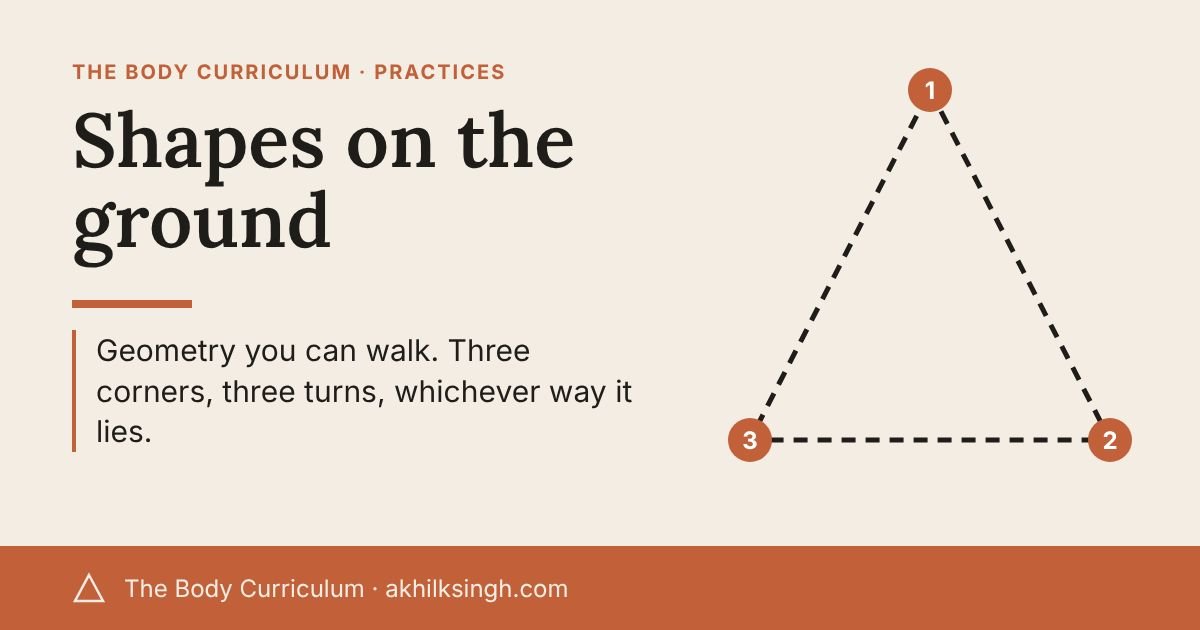
Begin outside, with chalk and a rope about eight to ten metres long. Draw a large triangle on the ground, six or seven steps a side. Ask five or six children to walk its line slowly, one behind the other, stopping at each corner to notice what their body does there. They will tell you they had to turn. Ask how many times.
Then draw a square beside it and walk that. Four turns, and each turn feels the same. Next, walk a long, thin triangle, and then one lying on its side. Do they still turn three times? This is often where the doubtful child changes her mind. Her feet have told her what her eyes did not.
After that, hand the rope to the group, each child holding a corner. Three children make a triangle however they stand. Four will argue, happily, about whether theirs is a square, so let them pace the sides to settle it. For a circle, one child stands still holding one end while another walks around her with the rope pulled straight.
Finally, bring the children back to their slates and ask each one to draw the shape they walked, marking every corner where they turned.
The practice takes twenty to twenty-five minutes and suits children from about six to eleven. Do it once or twice a week while the class is working on shapes, with the rest of the class watching and predicting the turns. Keep the ground flat and clear, and ask children to walk, not run. If you add a version with eyes closed, a partner walks alongside, and any child may keep her eyes open.
What to watch for
When it is working, children slow down at the corners without being told, and their hands start to move. Watch for the moment a child stops looking and starts reasoning. “It has to be a triangle, we only turned three times.”
When it is not working, the walk turns into a race and nobody notices the corners. Slow the group down and make each stop deliberate. A child who does not want to walk while others watch can hold the rope, call out the turns, or walk later. Never pull a child into the line by the hand. If a child keeps losing balance on simple turns or cannot follow a straight line at all, mention it gently to the parents and suggest a check with a doctor or an occupational therapist.
Why it works
Seymour Papert built the turtle geometry of his Logo programming language on the idea that children could identify with the turtle and bring what they knew about their own moving bodies to mathematics. Douglas Clements and Julie Meredith, reviewing the research on Logo, drew on Jean Piaget to argue that a child’s early ideas of shape grow out of action. Walking a straight path gives a felt sense of straightness. They also warned that the teacher has to connect the turn to the idea of an angle.
Clements and his colleagues found that children between three and six first recognise shapes largely by how they look. Walking gives the child a second way in. In a study by Carmen Petrick Smith and her colleagues, third- and fourth-grade children who made angles with their arms made significant gains in understanding angles, and movement worked best alongside other teaching.
None of this is new. The Śulbasūtras, some more than two and a half thousand years old, give rules for laying out altars with a measuring cord. What the child’s feet learn here is what enaction means, that knowing is something the body does. Her sense of where she is and how far she has turned, her proprioception, becomes the place where the idea of a corner lives. So which is the real shape, the one on the page or the one the child walked?
Why this works: R2 Enaction: knowing as a form of doing; R8 Proprioception: the forgotten sense of learning; R35 Piaget: intelligence begins in movement
Next in Number through the body: P34 Number lines children stand on
Notes
- Papert, S. (1980). Mindstorms: Children, Computers, and Powerful Ideas. New York: Basic Books.
- Clements, D. H., & Meredith, J. S. (1992). Research on Logo: Effects and Efficacy. Logo Foundation. el.media.mit.edu
- Clements, D. H., Swaminathan, S., Hannibal, M. A. Z., & Sarama, J. (1999). Young children’s concepts of shape. Journal for Research in Mathematics Education, 30(2), 192–212. doi.org/10.2307/749610
- Smith, C. P., King, B., & Hoyte, J. (2014). Learning angles through movement: Critical actions for developing understanding in an embodied activity. Journal of Mathematical Behavior, 36, 95–108. doi.org/10.1016/j.jmathb.2014.09.001
- O’Connor, J. J., & Robertson, E. F. (2000). The Indian Sulbasutras. MacTutor History of Mathematics, University of St Andrews. mathshistory.st-andrews.ac.uk