The moment
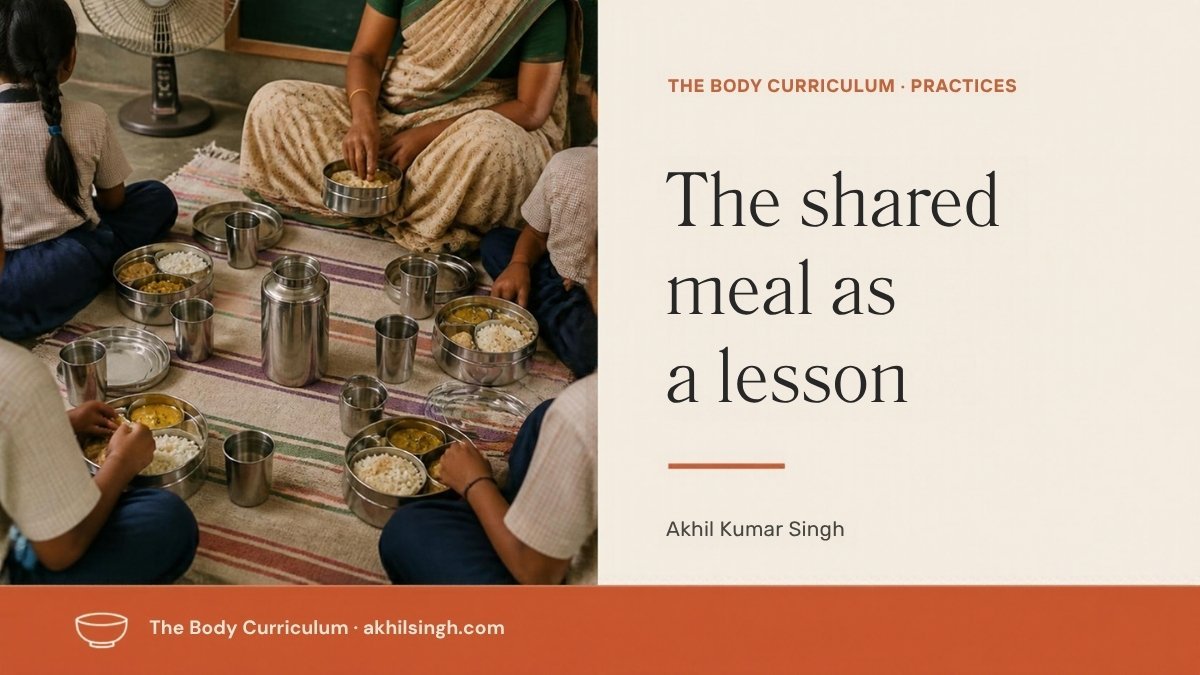
The lunch bell rings and lids clatter open. Rice, fried onion and pickle scent the warm air under the fan. Children bend over their own boxes, elbows out. One boy finishes in four minutes and is gone. A girl by the window pushes the same three mouthfuls around and quietly shuts the lid. At the front, the teacher eats with one hand and corrects notebooks with the other. Twenty minutes later the bell rings again.
Nothing was taught in those twenty minutes. Or was it?
The practice
Begin by treating lunch as a daily lesson of twenty to thirty minutes, with the whole class or tables of six to eight. You need a mat or desks pushed together, a jug of water and cups. Every child washes their hands first. Two children pour water for the group, and these small roles change daily so everyone gets a turn.
Then sit down with the children, at their level, and eat with them. Eat the same food when the school serves a meal, or bring your own box into the circle. Before the first mouthful, pause for a few seconds of quiet or a line of thanks the class has chosen for the people who grew and cooked the food.
While everyone eats, offer the table one small question. Is this sour or sweet, soft or crunchy? Where does it grow? This is the natural home for tasting and naming. Let each child decide how much to eat. Serve small portions and allow seconds. Offer a new food as a single taste, accept a refusal with a nod, and offer it again another day. Never praise a clean plate, never use food as reward or punishment, and never comment on how much a child eats or on their size.
Finally, finish together. Everyone carries their own box, wipes their own space and helps roll the mat. This cleaning up is part of the meal.
A safety note. Ask parents which children have food allergies or follow dietary or religious rules, and keep a list. Offer no new food without checking. Children should not swap food unless the school allows it and it is safe for both.
What to watch for
When it is working, you see it in the body first. Shoulders drop. Children eat slowly and look up. A quiet child passes the jug without being asked. Someone tastes something new, pulls a face, and the table laughs with them, not at them.
When it is not, children guard their boxes, gulp, or mock another child’s food. Deal with food teasing at once, calmly, every time. A child who wants to sit apart may sit nearby; keep a place open, but never pull them in. Talk to parents if a child regularly eats almost nothing, often seems very hungry or comes without food, or gags at many textures. If eating is very limited, weight is falling or mealtimes cause real distress, suggest the family see a doctor.
Why it works
Elsa Addessi, Leann Birch and colleagues found that children aged two to five ate more of an unfamiliar food when an adult beside them ate a food that looked the same; an adult merely present, or eating something different, mattered much less. This is imitation at its plainest, and it is why the teacher eats with the children, not near them. Jane Wardle and her team found that a small daily taste of one vegetable for fourteen days raised children’s liking for it. When Amy Galloway and colleagues pressured preschoolers to finish their food, the children ate less and complained more.
A meal is also where a child learns to listen to hunger and fullness from the inside. Every “finish your plate” teaches obedience to a voice from outside instead. Japan’s Basic Act on Shokuiku (2005) calls food education fundamental to intellectual, moral and physical education, and in many Japanese schools children serve lunch to their classmates. Robin Dunbar’s survey of British adults found that people who eat with others more often report more trust and closer friendships, though a survey cannot fully settle cause.
None of it works without trust. A child who fears the meal tastes nothing new. So what is your class learning at lunch now, when nobody thinks it is a lesson?
Why this works: R9 Interoception: how hunger, fear and calm shape readiness to learn · R18 Śraddhā: trust as a condition for learning · R42 Imitation: children learn by becoming others · R45 Sleep, food and attention: the body behind the report card
Next in Eating and caring: P47 Washing and cleaning up: care as curriculum
Notes
- Addessi, E., Galloway, A. T., Visalberghi, E., & Birch, L. L. (2005). Specific social influences on the acceptance of novel foods in 2–5-year-old children. Appetite, 45, 264–271. https://doi.org/10.1016/j.appet.2005.07.007
- Wardle, J., Cooke, L. J., Gibson, E. L., Sapochnik, M., Sheiham, A., & Lawson, M. (2003). Increasing children’s acceptance of vegetables: a randomized trial of parent-led exposure. Appetite, 40(2), 155–162. https://library.fabresearch.org/viewItem.php?id=8398
- Galloway, A. T., Fiorito, L. M., Francis, L. A., & Birch, L. L. (2006). ‘Finish your soup’: Counterproductive effects of pressuring children to eat on intake and affect. Appetite, 46(3), 318–323. https://doi.org/10.1016/j.appet.2006.01.019
- Government of Japan. Basic Act on Shokuiku (Food and Nutrition Education) (Act No. 63 of 2005). Japanese Law Translation. https://www.japaneselawtranslation.go.jp/en/laws/view/3419/en
- Global Voices (2015, 24 September). How school lunch plays a central role in education in Japan. https://globalvoices.org/2015/09/24/how-school-lunch-plays-a-central-role-in-education-in-japan/
- Dunbar, R. I. M. (2017). Breaking bread: the functions of social eating. Adaptive Human Behavior and Physiology, 3(3), 198–211. https://doi.org/10.1007/s40750-017-0061-4