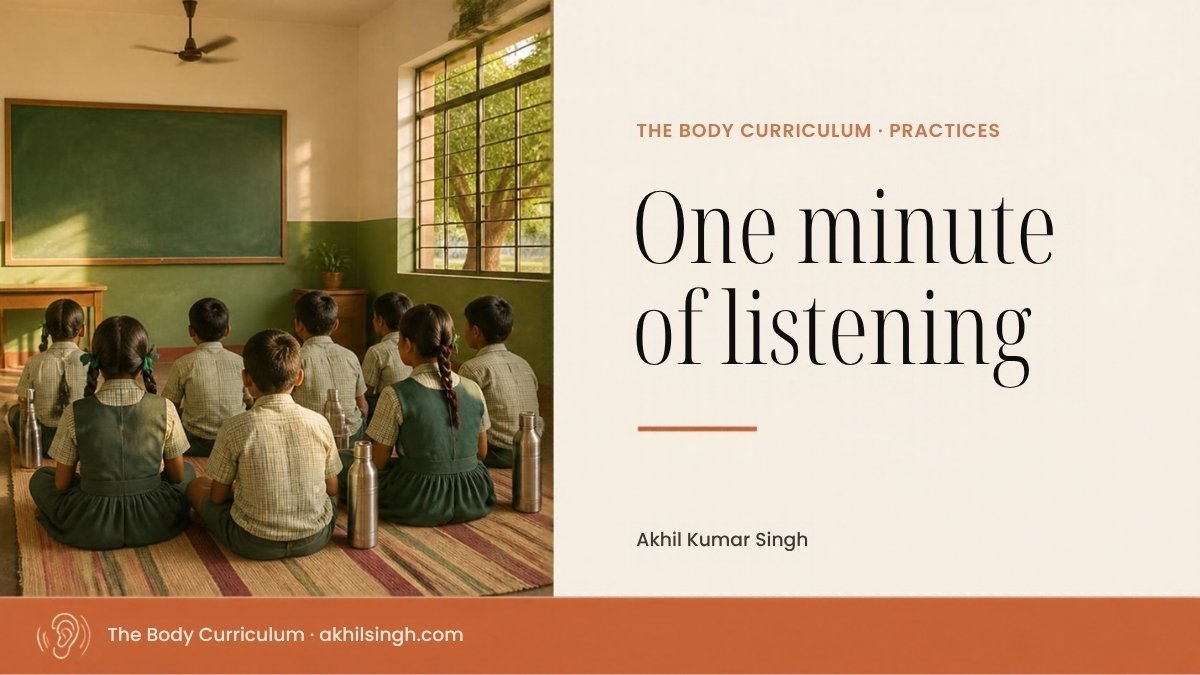
The moment
It is the third period and the room has a hum to it that nobody chose. The ceiling fan clicks on every turn. Pencil shavings curl onto the floor, a ruler taps against a desk, and from the corridor comes another class reciting tables. The teacher raises her voice, and the children raise theirs to be heard over her. Nobody is misbehaving, exactly. The room has filled with sound the way a glass fills under a tap, and now it is spilling over. She could shout for quiet and buy ten stiff seconds. Or she could try something else.
The practice
Begin by telling the children, in an ordinary voice, what is about to happen. “For one minute we are going to listen to the room. Not to me. To everything else.” It works with the whole class, whether eight children or forty. You need a watch and one soft sound to start and end, such as a small bell or a tap on a steel tumbler.
Then invite them to settle the body first. Feet on the floor or legs crossed, hands resting, back easy. They may close their eyes or rest them on one spot on the floor, and no child is ever made to close them. Ask them to breathe normally, with no holding or counting. Give the signal and stay silent yourself. Your own stillness is half the practice, because children read the adult’s body before they hear the adult’s words.
When the minute ends, ask what they heard and take answers one at a time. The fan. A crow. Somebody’s stomach. A motorbike far away. My own breathing. Sort a few on the board into near and far, inside and outside. This takes three or four minutes, and it matters as much as the silence.
Finally, return to the lesson in a quieter voice. Do this once a day at the same point, perhaps when children are coming back in from recess or before a task that needs care. Over a few weeks you can stretch the minute to two, or take it outdoors on a learning walk.
What to watch for
When it is working, you see it in the body before anyone speaks. Shoulders drop. Fidgeting slows and then stops on its own. Over the weeks the lists grow finer, and a child who first heard only “noise” begins to hear the tap dripping next door.
When it isn’t working, the stillness looks rigid. Jaws tighten, eyes squeeze shut, and children glance at you to check whether they are being judged. That is imposed silence wearing the clothes of listening. Shorten the minute, keep the tone light, and laugh together at the sound that broke it.
Some children will giggle or refuse. Let them sit out quietly with something to hold, and invite them back each day without pressure. Never push a child who seems distressed by silence. If a child often misses soft sounds others report, or reacts to ordinary sounds with real pain or panic, speak gently with the parents about a hearing check or a specialist’s view.
Why it works
Silence does something measurable to the body. Luciano Bernardi and his colleagues played music to 24 adults with a two-minute pause between pieces, and during that pause heart rate, blood pressure and breathing fell below even the resting baseline. It was a small study of adults, not children, but it suggests a pause of quiet is not empty time. Noise works the other way. Bridget Shield and Julie Dockrell found that in London primary schools higher noise went with lower test scores, with background noise in occupied classrooms the internal measure most closely linked to results.
The practice is old. Maria Montessori described carrying a baby into her classroom, remarking on its silence, and watching the children soften their own breathing to match it. Her silence game grew from that moment. The composer R. Murray Schafer later wrote a whole book of listening exercises meant, in his phrase, to clean the ear.
Attention is something the body does, not an order the mind obeys. A child told to pay attention has nothing to do. A child asked to listen for the farthest sound has a task, and the body organises itself around it. The stillness that follows is a result of attending, not its precondition, and this is how concentration is grown rather than commanded. What would change in our schools if we stopped demanding silence from children and began inviting them into it?
Why this works: R12 Attention is a bodily act, not a mental effort · R24 Ekāgratā: concentration that is cultivated, not commanded · R50 When stillness is mistaken for attention
Next in Silence and attention: P42 Watching closely: observation as a practice
Notes
- Bernardi, L., Porta, C. and Sleight, P. (2006). Cardiovascular, cerebrovascular, and respiratory changes induced by different types of music in musicians and non-musicians: the importance of silence. Heart, 92(4), 445–452. https://pmc.ncbi.nlm.nih.gov/articles/PMC1860846/
- Shield, B. M. and Dockrell, J. E. (2008). The effects of environmental and classroom noise on the academic attainments of primary school children. Journal of the Acoustical Society of America, 123(1), 133–144. https://doi.org/10.1121/1.2812596
- Montessori, M. The Secret of Childhood. The origin of the silence game is described by the Association Montessori Internationale: https://montessori-ami.org/node/7042
- Schafer, R. M. (1992). A Sound Education: 100 Exercises in Listening and Sound-Making. Arcana Editions. https://omeka.uottawa.ca/schafer360/items/show/74