The moment
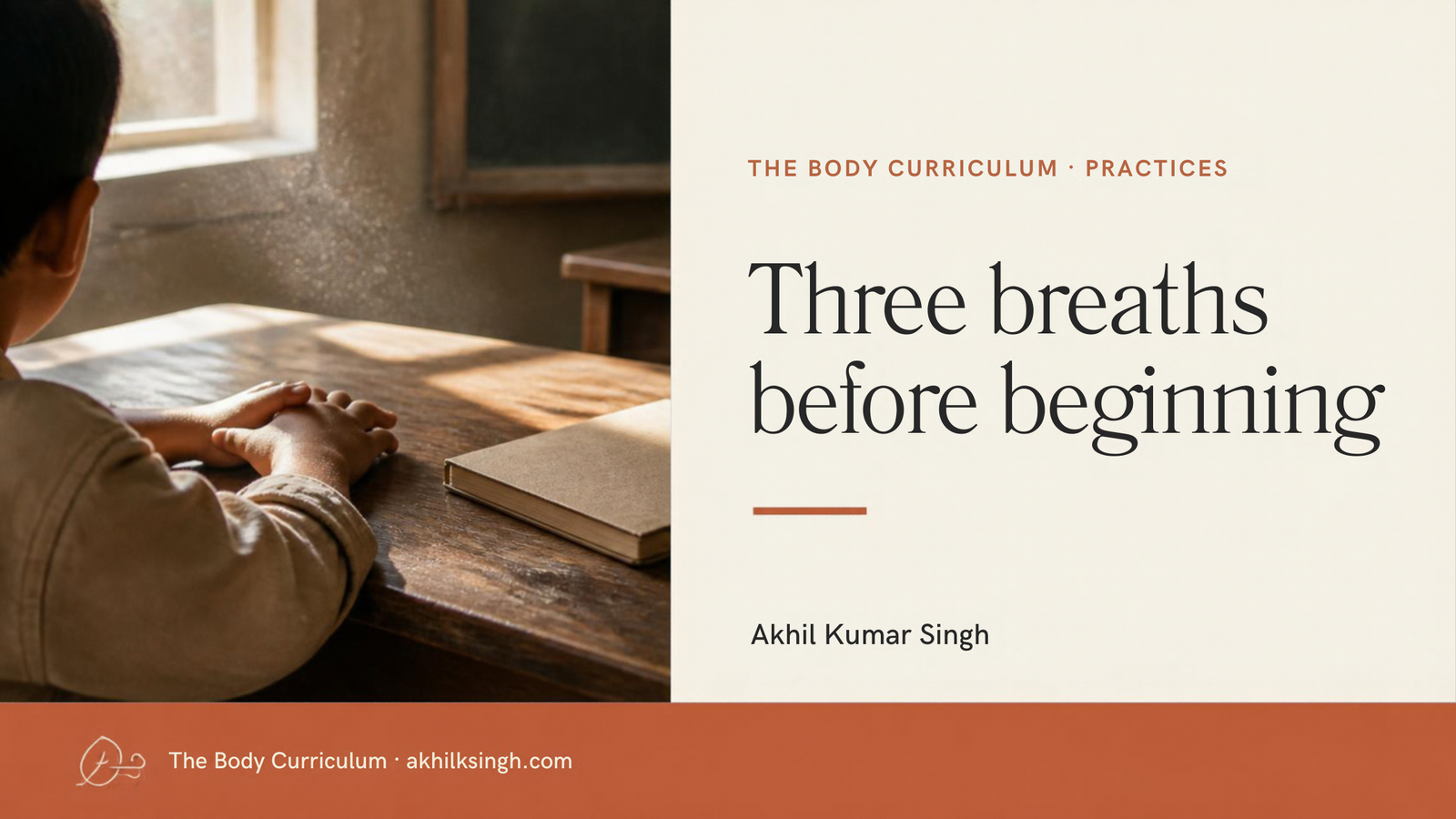
The bell has rung and the children are in their places, but the room has not arrived. A bag zip is still rasping somewhere at the back. Two boys are finishing an argument in whispers. A girl near the window is breathing fast, cheeks warm from the stairs, and the air smells of chalk dust and damp shoes. You open the book and begin. Ten minutes later you are still talking to bodies that are somewhere else.
Every teacher knows this gap between children sitting down and children being ready. We usually try to close it with a louder voice. There is a quieter tool, and every child carries it in.
The practice
Begin by standing still at the front, book closed, until most eyes find you. Then say, in an ordinary voice, “Three breaths before we begin.” The whole class takes part, twelve children or sixty, and you need no materials.
For the first breath, ask the children simply to notice the air coming in and going out, through the nose if that is comfortable. For the second, invite a slow breath out, a little longer than the breath in, as if cooling a cup of tea. For the third, ask them to feel their feet on the floor and their hands resting still, and then to look at you. Breathe with them every time. Children copy your shoulders far more than your words.
The whole thing takes about thirty seconds. Do it at the start of every lesson, or at least each morning and after each break, so that it becomes a habit the class owns rather than a trick for noisy days. Eyes may stay open or rest on the desk. No child should ever be told to close them. Never ask anyone to hold the breath, and never count breaths as a test.
What to watch for
When it is working, you will see shoulders drop and jaws loosen, and you will hear the room’s sound fall by itself. After a few weeks, some children will start the three breaths before you ask. When it is not working, you will see big gasping breaths, giggling or red faces, which usually means the breaths are too deep or too fast. Say “softer, smaller” and slow your own breath down.
If a child refuses, let them sit and watch. Refusal is information, not defiance, and many children join in on their own within a week. If a child often wheezes, seems short of breath or turns panicky or dizzy, speak to the parents and suggest a doctor. Children with asthma should breathe gently and stop at any discomfort. A child who seems anxious every morning may need a school counsellor.
Why it works
Slow breathing changes the state of the body. A systematic review by Zaccaro and colleagues found that breathing below about ten breaths a minute was linked with greater heart rate variability, a sign of the body’s calming system at work, along with reports of relaxation and alertness. The authors admit the studies were few and small. Yilmaz Balban and colleagues found that five minutes a day of breathing that lengthens the out-breath lifted adults’ mood more than a mindfulness meditation did. With children, a small pilot by Denise Bothe and colleagues in two third-grade classes reported lower anxiety after a daily ten-minute routine that included deep breathing.
We should also be careful. The MYRIAD trial, with more than eight thousand adolescents, found that a full school mindfulness course did no better than usual teaching. Breath is not a programme that fixes children. Three breaths ask for something smaller, a pause in which the body is allowed to arrive.
Patañjali described breath that is watched becoming long and subtle, and the Buddha’s teaching on mindfulness of breathing begins by simply knowing a long breath as long. Neither asks for force. This is prāṇa as the rhythm of attention. Attention is a bodily act, and stillness is not the same as attention. A child cannot listen while the heart is still racing from the stairs, and interoception, the sense of one’s own inner state, is where readiness begins. Three breaths come naturally after the threshold and lead well into counting breaths or humming together when a group needs more. What would change in our schools if every lesson began by asking whether the body is ready, instead of assuming it is?
Why this works: R14 Prāṇa: breath and the rhythm of attention · R9 Interoception: how hunger, fear and calm shape readiness to learn · R12 Attention is a bodily act, not a mental effort · R24 Ekāgratā: concentration that is cultivated, not commanded
Next in Breath and settling: P7 Counting breaths: settling a restless group
Notes
- Zaccaro, A., Piarulli, A., Laurino, M., Garbella, E., Menicucci, D., Neri, B., & Gemignani, A. (2018). How breath-control can change your life: A systematic review on psycho-physiological correlates of slow breathing. Frontiers in Human Neuroscience, 12, 353. https://doi.org/10.3389/fnhum.2018.00353
- Yilmaz Balban, M., et al. (2023). Brief structured respiration practices enhance mood and reduce physiological arousal. Cell Reports Medicine, 4(1), 100895. https://pmc.ncbi.nlm.nih.gov/articles/PMC9873947
- Schneider, M. E. (2006, 1 November). Daily stress management can work in classroom setting. MDedge Psychiatry. Report of the pilot study by Denise Bothe and colleagues. https://mdedge.com/content/daily-stress-management-can-work-classroom-setting
- Kuyken, W., Ball, S., Crane, C., et al. (2022). Effectiveness and cost-effectiveness of universal school-based mindfulness training compared with normal school provision in reducing risk of mental health problems and promoting well-being in adolescence: the MYRIAD cluster randomised controlled trial. Evidence-Based Mental Health, 25(3), 99–109.
- Patañjali, Yoga Sūtra 2.50. Translation at Satyori: https://satyori.com/source-texts/yoga-sutras-of-patanjali/sadhana-pada/50/
- Ānāpānasati Sutta: Mindfulness of Breathing (Majjhima Nikāya 118), trans. Thanissaro Bhikkhu. Access to Insight: https://www.accesstoinsight.org/tipitaka/mn/mn.118.than.html
1 thought on “Three breaths before beginning”