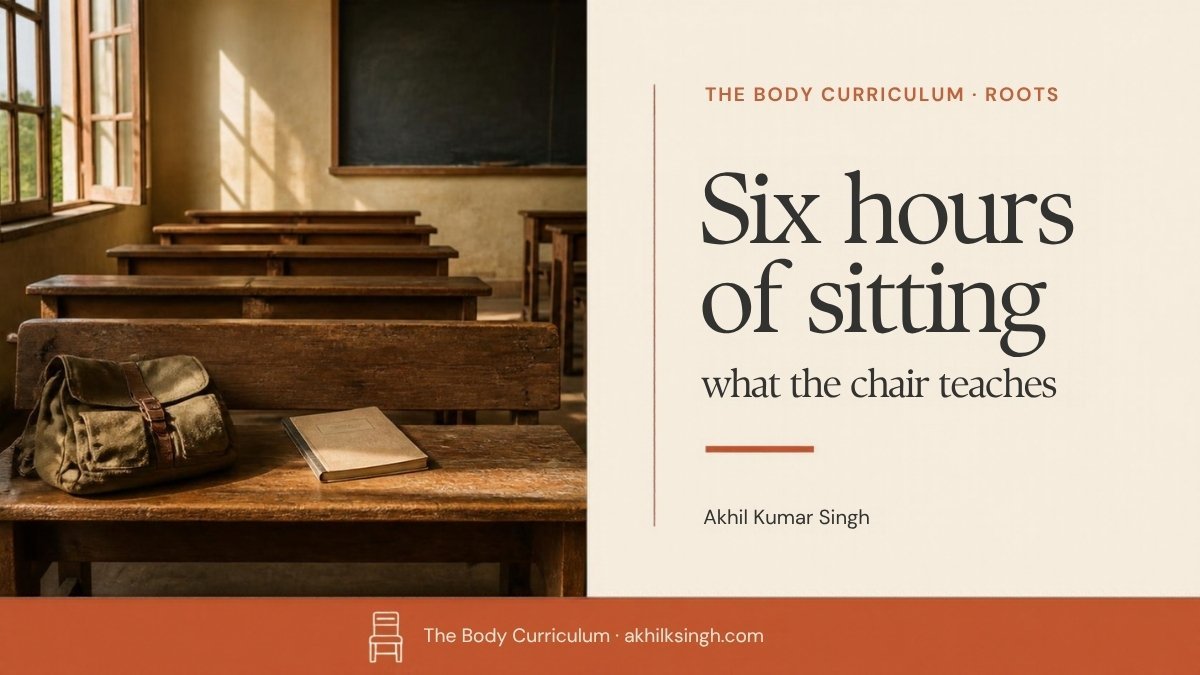
It is the seventh period on a September afternoon. The ceiling fan turns slowly and pushes the warm air around without cooling it. Forty children sit on wooden benches made for someone else’s legs, elbows touching. A boy near the window has hooked one foot around the leg of the bench and is rocking gently back and forth. A girl in the second row rests her cheek on her palm, then on her forearm, then sits up sharply when the teacher’s chalk taps the board. Nobody has mentioned bodies all day, yet every body in the room has been taught something since the morning bell.
What the chair asks of a child
Count it up. Assembly, six or seven hours of periods, tuition in the evening, homework at the dining table. For most of a child’s waking day the body is folded at the hips and knees and held there. We think of this as the condition for teaching, not as teaching.
But a posture held for years is a lesson. The chair teaches that learning happens from the neck up. It teaches that a good student is a still one, that restlessness is a fault of character, that the body must be managed so the mind can work. None of this is in any syllabus. It is learned all the same, and deeply, because it is learned through the body itself. This is what embodied cognition asks us to take seriously. If thinking is not only in the head, then what we do with the body all day is not neutral.
Where the habit comes from
Sitting at a desk feels so natural that we forget it has a history. The architect Galen Cranz, in her book The Chair, argues that the chair was never mainly about comfort. It marked status, and right-angled seating held for long hours is hard on the human body. She points out that much of the world has eaten, worked and rested without chairs, on mats, divans and the floor. Many Indian readers will remember a grandparent who sat cross-legged for hours and rose without using their hands.
In Discipline and Punish, Michel Foucault described how schools, armies and hospitals in early modern Europe learned to produce “docile bodies” through timetables, fixed places and the exact control of gesture. Good handwriting, he wrote, presupposes a kind of gymnastics, a routine that takes hold of the whole body from the feet to the tip of the index finger. The anthropologist Marcel Mauss had made a related point earlier. Ways of walking, sitting and standing are “techniques of the body”, learned by imitation of people a child trusts and looks up to. So when the bench and the desk became the ordinary furniture of school, what exactly were children being trained to become?
What the measurements show
Ole Sprengeler and his colleagues fitted German third graders with activity monitors and found that, at the start of their study, the children spent around 60 per cent of lesson time and about 30 per cent of break time sitting. When the school installed height-adjustable standing desks, sitting in lessons fell, though it fell in the comparison classes too. Furniture alone is not the whole story. Ergonomists led by Castellucci, studying more than two thousand students, note that a mismatch between a child’s body and the size of the furniture is likely to bring uncomfortable posture and pain.
So the rocking boy by the window may not be disobedient at all. His body may simply be looking for relief, and for the small movements that keep it awake to the world. When we call that indiscipline, we teach him that his body is a problem. When we praise the motionless child as attentive, we have confused stillness with attention.
More than a movement break
The usual answer is the movement break. Two minutes of stretching, yoga on Fridays. There is evidence that this helps. Donnelly and Lambourne reported that physically active academic lessons improved scores on a standardised achievement test by around 6 per cent, against a small fall in comparison classrooms.
But notice what the argument assumes. The body is still a tool for the mind, something to be switched on so that marks go up. If the gains disappeared tomorrow, would we put the children back in their rows without a second thought? A child does not have a body that helps her learn. She is a body that learns, and attention itself is something she does with her whole self. The real question is what kind of person a sitting day is shaping, and whether we would choose that openly. The hidden curriculum of the body is still a curriculum.
Go back to that seventh period. Somewhere in the timetable there is a PE period, two or three times a week, as though the body could be given its turn and then put away again. These children will spend thousands of hours at a desk before they leave school. Long after the lessons have faded, what will their bodies remember of all that sitting?
Put it into practice: P11 · Sitting on the floor and on chairs: what each does to attention; P12 · Changing position every twenty minutes; P14 · Standing to think: when to let children learn on their feet
Read next: R50 · When stillness is mistaken for attention; R47 · Sitting still: what a young body can and cannot do
Notes
- Cranz, G. (1998). The Chair: Rethinking Culture, Body, and Design. New York: W. W. Norton.
- Foucault, M. (1977). Discipline and Punish: The Birth of the Prison (A. Sheridan, Trans.). London: Allen Lane. See the chapter “Docile Bodies”.
- Mauss, M. (1973). Techniques of the body (B. Brewster, Trans.). Economy and Society, 2(1), 70–88. First published in French in 1935 in Journal de psychologie normale et pathologique.
- Sprengeler, O., Hebestreit, A., Gohres, H., Bucksch, J., & Buck, C. (2020). Effects of installing height-adjustable standing desks on daily and domain-specific duration of standing, sitting, and stepping in 3rd grade primary school children. Frontiers in Public Health, 8, 396. https://doi.org/10.3389/fpubh.2020.00396
- Castellucci, H. I., Arezes, P. M., & Molenbroek, J. F. M. (2014). Applying different equations to evaluate the level of mismatch between students and school furniture. Applied Ergonomics. https://doi.org/10.1016/j.apergo.2014.01.012
- Donnelly, J. E., & Lambourne, K. (2011). Classroom-based physical activity, cognition, and academic achievement. Preventive Medicine. https://doi.org/10.1016/j.ypmed.2011.01.021
For school leadersFor teachers