The moment
It is the last period before lunch. The fan stirs the warm air. After forty minutes of copying sums from the board, the room has gone heavy. A girl by the window has slid so low that her chin nearly rests on her notebook. Two boys at the back press their feet together under the bench, only to feel something move. Somebody yawns, long and loud, and three more yawns follow. Whatever the teacher explains next will land on nobody.
The practice
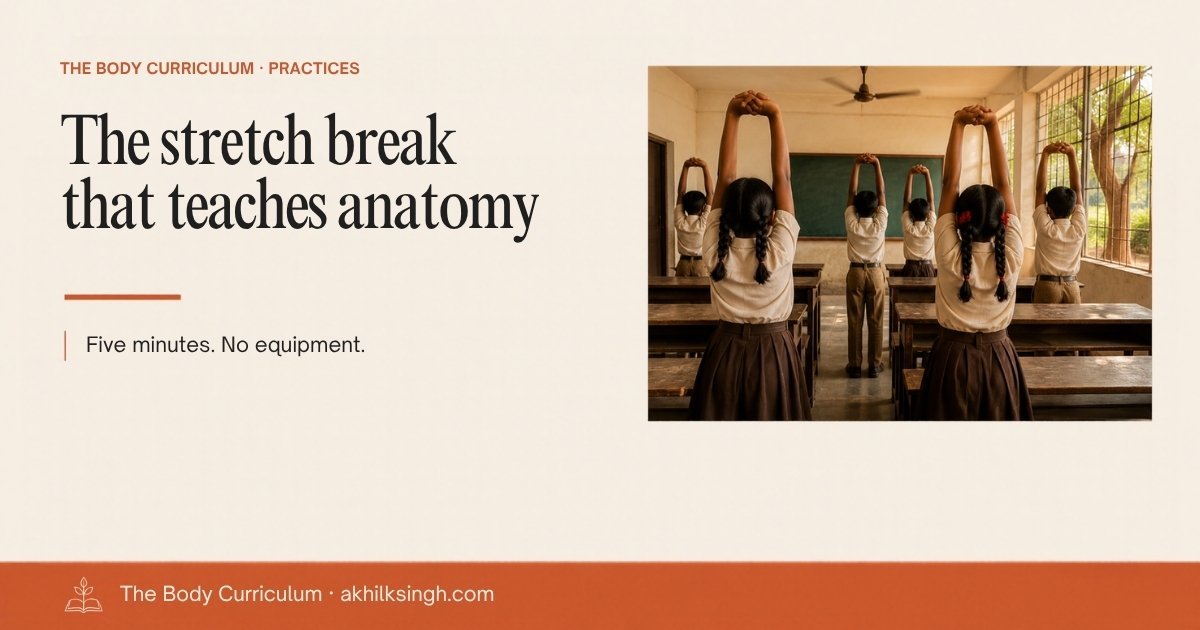
Begin by asking the children to stand beside their seats, each with room to swing an arm without touching anyone. The practice takes about five minutes, once or twice in a long morning, with the whole class, whenever bodies have been still for half an hour or more. You need only a little space and a chalk outline of a body on the board, drawn once and kept for the term.
Then choose one part of the body for the day and let the children find it by moving it. On the first day, take the upper arm. Ask them to make a tight fist, bend the elbow slowly and feel the front of the upper arm harden under the other hand. Give the name, biceps, and say what it does. It pulls the forearm up. Now straighten the arm and feel the back of it take over. That is the triceps, and the children have just found out that muscles work in pairs.
On other days, bend and straighten the knee and feel the kneecap slide, or do ten small jumps on the spot and count the pulse at the wrist.
Finally, ask everyone to sit and answer one question. Where did you feel it? Let each child point to the place on their own body before saying a word. Each week, a few children mark the class’s findings on the chalk outline, and by the end of term it is full of bones, joints, muscle pairs and a beating heart.
Show every stretch on your own body, never touch a child to correct one, and count a smaller or seated version as fully done.
What to watch for
When it is working, children get up without groaning, point to the right place quickly and start using the names on their own. They sit back down with longer backs, quieter feet and brighter eyes.
When it is not working, the break turns into a scramble or the slumped child stays slumped. Slow everything down, speak low and cut the stretch to two movements. If a child refuses to stand, let them do the arm version sitting down, or give them the job of calling out the body part. Do not insist. Older children, especially in the years when the body turns self-conscious, may prefer to keep to hands, arms, legs and back.
If a child often loses balance, complains of joint pain or tires far faster than others, mention it gently to the parents and suggest a doctor or physiotherapist.
Why it works
Short movement breaks help children return to the work. Matthew Mahar and his colleagues had teachers lead a daily ten-minute activity break built around lesson content for twelve weeks. On-task behaviour rose from about 71 to 79 per cent, and the least focused children gained the most. A 2017 review of 39 studies by Amanda Watson and her colleagues found that most reported short-term gains in on-task behaviour, though the authors warn that much of this research is of modest quality. The World Health Organization’s 2020 guidelines ask children to limit sedentary time.
When Michael Reiss and Sue Dale Tunnicliffe asked 158 learners, from four-year-olds to university students, to draw what is inside the body, almost all drew a heart and most drew some bones, yet none drew a complete muscular system. Children know parts and rarely know how they connect. A stretch gives them a muscle system they can feel working. In a small study with adults, Mathilde Cherdieu and her colleagues found that people who copied gestures while learning forearm anatomy remembered more days later than those who only watched.
The sense that tells a child where their arm is without looking, which scientists call proprioception, is what makes the word biceps mean something. In five minutes a child learns with the body and about the body at once. So why do we ask children to sit still for hours in a body nobody has taught them to know?
Why this works: R8 Proprioception: the forgotten sense of learning; R4 Body schema: the body a child learns with; R11 Gesture as thinking: what the hands know before words; R49 Six hours of sitting: what the chair teaches
Next in Sitting and posture: P14 Standing to think: when to let children learn on their feet
Notes
- Mahar, M. T., Murphy, S. K., Rowe, D. A., Golden, J., Shields, A. T., & Raedeke, T. D. (2006). Effects of a classroom-based program on physical activity and on-task behavior. Medicine & Science in Sports & Exercise, 38(12), 2086–2094. https://doi.org/10.1249/01.mss.0000235359.16685.a3
- Watson, A., Timperio, A., Brown, H., et al. (2017). Effect of classroom-based physical activity interventions on academic and physical activity outcomes: a systematic review and meta-analysis. International Journal of Behavioral Nutrition and Physical Activity, 14, 114. https://doi.org/10.1186/s12966-017-0569-9
- World Health Organization. (2020). WHO Guidelines on Physical Activity and Sedentary Behaviour. Geneva: WHO. https://www.ncbi.nlm.nih.gov/books/NBK566048/
- Reiss, M. J., & Tunnicliffe, S. D. (2001). Students’ understandings of human organs and organ systems. Research in Science Education, 31(3), 383–399. https://doi.org/10.1023/A:1013116228261
- Cherdieu, M., Palombi, O., Gerber, S., Troccaz, J., & Rochet-Capellan, A. (2017). Make gestures to learn: reproducing gestures improves the learning of anatomical knowledge more than just seeing gestures. Frontiers in Psychology, 8, 1689. https://doi.org/10.3389/fpsyg.2017.01689