The work-experience period comes after lunch. Forty children in a Class VI room bend over sheets of crêpe paper, and the air smells of glue and warm dal from the corridor. Scissors squeak, a ceiling fan turns slowly overhead, and small fingers grow sticky and pink with dye. By the bell there are thirty-odd paper roses on the teacher’s table, meant for the annual day stage. Nobody has asked how paper takes colour or why the glue holds. The roses go into a carton and the science books come out. The real lesson, everyone understands, begins now.
Eighty-nine years ago, Gandhi proposed a school that would turn this order upside down.
What Gandhi asked for
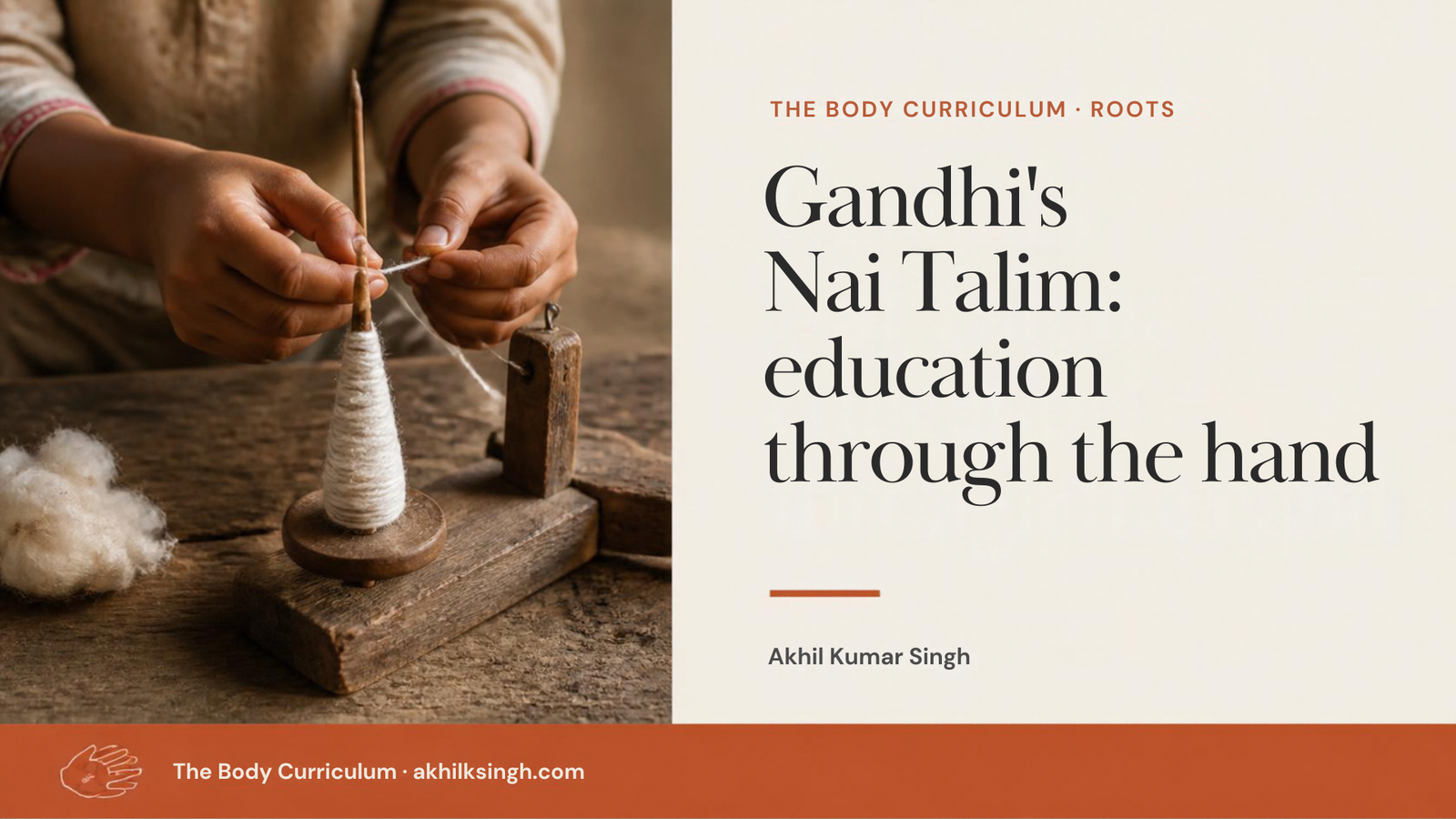
Nai Talim means “new education” in Hindustani. The idea is easy to state and hard to live by. A child learns through a productive craft such as spinning, weaving, gardening or carpentry, and the rest of the curriculum grows out of that work. Arithmetic comes from counting yarn. Geography comes from asking where the cotton grew. The craft is not a period at the edge of the timetable. It is the centre.
Writing in Harijan in July 1937, Gandhi said that by education he meant an all-round drawing out of the best in the child, in body, mind and spirit, and that literacy was neither the end of education nor even its beginning. A few months earlier he had gone further. True education of the intellect, he argued, can come only through the proper exercise and training of the bodily organs, the hands and feet, the eyes, ears and nose. Decades later, research on embodied cognition would make a similar claim, that thinking is not sealed inside the skull.
From Tolstoy Farm to Wardha
The idea did not come from a desk. In South Africa, at Tolstoy Farm, Gandhi ran a settlement with no servants, where everyone, young and old, cooked, cleaned, dug and gardened. He learnt shoemaking so that he could teach the boys, and he held to one rule. Children should not be asked to do what their teachers did not do. He writes that the young people mostly took delight in the work, and that some of them shirked.
In October 1937 a national education conference met at Wardha. It resolved that free and compulsory education should be given for seven years, in the mother tongue, centred on manual and productive work drawn from the child’s own surroundings, and that this work should help pay the teachers. A committee under Zakir Husain then drew up the scheme and a detailed syllabus in 1938, built around craft, the correlation of every subject with that craft, and learning by doing.
What he saw, and what he missed
Gandhi saw something most schools still refuse to see. The hand is not a servant waiting for the mind’s instructions. It is one of the ways a child comes to know anything at all. He also insisted that a craft be taught scientifically and not mechanically, so that the child understands the reason behind every step. Our paper roses never receive that dignity.
But look at what the scheme asked the body to be. A producer. Gandhi wanted the child to produce from the moment training began, and Wardha wanted that production to help pay for the school. Krishna Kumar records that the novelist Mulk Raj Anand feared the scheme would legitimise child labour. The worry was not foolish. A body valued for what it makes is still a body valued for its output.
What goes missing is the body that dances, sings, lies on its back to watch clouds, and wastes an afternoon in a way no account book can justify. At Santiniketan, Tagore had been holding classes in the open air, in the shade of trees, since 1901. Play has no product. Neither does rest. Gandhi’s learning body is earnest, disciplined and useful, and children are not only that.
Beyond the useful hand
After independence, as Krishna Kumar notes, India chose an industrial model of development, and the Kothari Commission report of the mid-1960s pushed craft away from the centre of schooling. Today the hand comes back mostly as “activity”, a way to make lessons stick, or as vocational training for children who are expected to become workers.
Both versions are instrumental. Both treat the body as a tool for something else, marks in one case and money in the other. This series takes a different view. The hand matters because a learner is a body that knows through doing, and kauśala (skill in action) is part of who a person becomes, not a route to a result. Gandhi came closer to this than almost anyone in his century, yet he tied it to usefulness.
So go back to that Class VI room and its carton of paper roses. If a craft is neither an exam aid nor a source of income, what would it mean to let a child’s hands simply come to know something, and to count that as education?
Put it into practice: P19 Making one small thing with a purpose · P20 Soil and seeds: a classroom garden as hand learning · P47 Washing and cleaning up: care as curriculum
Read next: R26 Tagore at Santiniketan: learning under an open sky · R31 Montessori: the hand as the instrument of the mind
Notes
- M. K. Gandhi, Harijan, 31 July 1937, p. 197; and Harijan, 8 March 1935, p. 28. Collected in R. K. Prabhu and U. R. Rao (eds.), The Mind of Mahatma Gandhi, chapter 79. mkgandhi.org
- M. K. Gandhi, Harijan, 8 May 1937, p. 104. Collected in Towards New Education, chapter 11. mkgandhi.org
- M. K. Gandhi, An Autobiography or The Story of My Experiments with Truth, trans. Mahadev Desai, Part IV, chapter 32, “As Schoolmaster”. Online text
- Wardha Educational Conference, 22 to 23 October 1937, resolutions as summarised in “Wardha Scheme of Education 1937”, GKToday. gktoday.in
- Basic National Education: Report of the Zakir Husain Committee and the Detailed Syllabus, with a foreword by Mahatma Gandhi (1938). South Asia Commons
- Krishna Kumar, “Crafts at school”, Seminar 570 (2007). india-seminar.com
- Visva-Bharati, “History”, on the founding of the Santiniketan school on 22 December 1901 and its open-air classes. visvabharati.ac.in
For teacher educatorsFor teachers
1 thought on “Gandhi’s Nai Talim: education through the hand”